
| No | Name | Description |
|---|---|---|
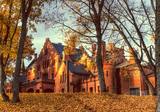 |
Castle's prototype is England's Windsor castle. Sangaste Castle was finished in 1883. Its last owner was Friedrich von Berg (1845. - 1938.) - known grain selector. Near the castle is a park. |
|
 |
No 28 m augstā torņa, kas atrodas uz apdzīvotas „salas” – Siksalas Teiču purva vidū, paveras ļoti plaša augstā purva ainava ar Siksalas ezeru, citām minerālzemes salām un Siksalas mazciemu. Tā kā tornis atrodas Teiču dabas rezervātā, to var apmeklēt tikai Dabas aizsardzības pārvaldes inspektora pavadībā, iepriekš piesakot vizīti T: + 371 28333415. |
|
 |
Go horseback or wagon riding all year long, find contacts with goats, sheep, chickens, turkeys, geese, and ducks, and taste smoked goat cheese. The owner also produces Christmas and other decorations. |
|
 |
Approximately one kilometre to the west of the former Vārnava school, you will find the Rudzīši homestead, which is owned by Ēvalds Pūpols and his family. Ēvalds has spent most of his life cultivating grapes and developing new varieties thereof. On the hilly territory, he has established a beautiful and well-tended area to grow grapes that love warmth. The vineyard has approximately 60 types of grapes. Facing south-east, this is one of Latvia's largest and most diverse vineyards. There are many trails to learn about the garden and its beautiful surrounding area. The owner will offer guide services, and you can learn all about the growing and selection of grapes. You can purchase plants, and if the season has been productive, you can taste the grapes as such. Rudzīši hosts a harvest festival and other events. |
|
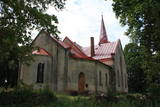 |
A bit less than one kilometre from the Aizkraukle castle hill, the church can be seen from the Rīga-Daugavpils highway (A6). The church was built in 1688 on the steep banks of the
|
|
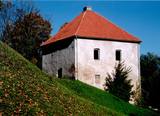 |
The square structure with walls that are nearly two metres thick became known as the Gunpowder Tower during the rule of Duke Jacob, because that is what was stored here. There might have been a well here, because groundwater is close to the surface. The tower and the castle were linked by a 12-metre bridge on one pillar. The tower is only visible from the outside. |
|
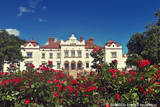 |
This is one of the most important cultural centres in Augštaitija, and the nobility of the buildings is emphasised by a park and ponds. |
|
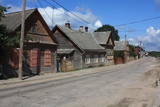 |
The wooden buildings with few floors emerged in the 19th century. Tourists can look at typical closed yards, verandas, wooden elements and decorations. The city suffered from fires in 1866 and 1938. The Market Square is the historical centre of Ludza, while the Ludza castle hill dominates the region. The streets of the city were established around the hill, which had an ancient Lettigalian wooden castle late in the 14th century. The Livonian Order replaced with the mightiest brick castle in Latgale. It was sacked in 1654 by the forces of Tsar Alexei Mikhailovich. The castle hill offers a lovely view of Latgale and the oldest city in Latvia and its historical centre. |
|
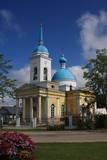 |
In the centre of the Old City, on the corner of Latgales and Baznīcas streets, the church was built in the style of Russian Classicism between 1843 and 1845. The ceiling and wall paintings were recently restored, and the bell in the steeple weighs 1,667 kg. |
|
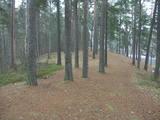 |
This territory is meant to protect the “green zone” of Rīga. Most of the park is covered with pine forest and dunes with shrubs on them, but Lake Beberbeķi is found at the southern end of the park. The area around the lake has been improved. |
|
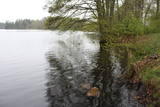 |
It is rare type of lake in Latvia and there are only of few this type of lakes in Kurzeme region. The lake is characterized by high water limpidness (very attractive for tourists) and very rare plant species for Latvia. Nature park includes the lake, costal area and forest on the East from the lake, few smaller lakes and Sarlote Pond. There are several tourist accommodations located around the lake.
|
|
 |
This is the grave of the
parents of Captain A. Bertholds with an unusual grave monument.
|
|
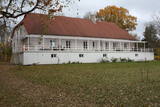 |
Muiža vēsturiskajos avotos ir minēta jau 1560. gadā. Tagad redzamā kungu māja ir celta no akmens 1805. g. Padomju laikos tajā atradās Matsalu rezervāta administrācija, bet mūsdienās ēkā ir izveidota viesnīca. Līdz muižai nokļūstam pa skaistu aleju, kuras apkaimē ir redzamas citas muižas kompleksa ēkas. |
|
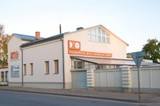 |
This centre is a workshop for eleven potters, including some from the “Potters School.” The centre offers various activities, including master classes, demonstrations of pottery work, and exhibitions of finished products. You can commission products or buy new ones. |
|
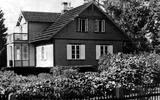 |
Reinis Kaudzīte, co-author of the first Latvian novel “Times of the Land-Surveyors” (“Mērnieku laiki”) stayed in Pēterupe Village from 1913. |
|
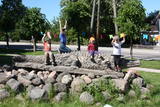 |
This 1995 sculpture by Oļegs Skarainis is at the corner of Dinsberģa and Talsu streets in Dundaga, near the local dairy. It is dedicated to the strong men of the town, including former Dundaga resident Arvīds Blūmentāls (1925-2006), who lived in Australia, was a great crocodile hunter (some 10,000 in all), and served as a prototype for Paul Hogan in the famous movie “Crocodile Dundee.” |
|
 8 days
|
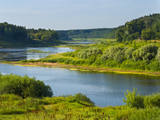
The Daugava River is known as our river of destiny, the Daugava of our hearts, or our beloved mommy. It is a large and full-blooded artery of water that has flowed through our land and our history. The Vikings were aware of the river during the 5th century AD. Krāslava is the site of an ancient castle hill, and the fearless sailors were well aware of it in that downriver from it, the ships could sail with raised sails. It is known in Viking sagas as Dynasaiforgarðr. Goods from the East sail down the river to Rīga, where it is reloaded into seafaring ships for delivery to Europe. That has been the case for many centuries. Many powers wanted to control and govern the process, as is seen in the large number of castle hills, castles and populated areas around the river’s banks. The majestic ruins of the Koknese Castle, Krustpils, the grassy and mighty castle hill at Aizkraukle, another one at Daugmale. The unique fortresses at Daugavgrīva and Daugavpils are like large keys that lock or unlock this mighty and ancient trade route. Under the water in the Daugava are the ruins of the ancient Ikšķile Castle that was built by St Maynard himself. It is seen as the first brick building in the Baltic States. Nearby is Death Island, where Latvian riflemen fought for the future of their country and their land, defending each square metre of land. The Daugava proved insurmountable for Bermont’s troops, and the riflemen defended Rīga successfully. The curves of Daugava are unique. The village of Slutišķi is particularly known because the Daugava there is just like it has been in the past. The high dolomite shorelines and canyons that once made the Daugava unique in all of Northern Europe have now been lost in the reservoirs of hydroelectric power plants, as has the eternally weeping cliff of Staburags, the Liepavotu stream and the Pērse waterfall. The age of national renaissance in Latvia importantly began with a battle against the construction of another power plant on the Daugava, which would have fully destroyed the beauty of the noble river. We managed to protect it, if only a small part of it, but we succeeded. We must not stop! |
|
|
|
The town's name in historical sources was first mentioned in 1224. In 1340 Archbishop of Riga built a stone castle at the Latgalian hill fort (now - the Lutheran Church). In 1802 (owned until 1920) Vecgulbene estate was bought by Baron G. Wolf. Manors in the surroundings of Gulbene and Vecgulbene castle substantially suffered during the Revolution in 1905 and in the further historical events. Today, there is a substantial change in the landscape, especially in the area of White Castle, where a large-scale restoration works occurred in recent years. Either way, - Gulbene is the place worth visit to get new impressions and knowledge. |
|
 |
The restaurant and deli is located in Cēsis, on the way from Valmiera. Modern interior, relaxed atmosphere and delicious dishes from the produce of local farmers. The menu is rich not only with meat and fish dishes, but also with a wide range of vegetarian dishes. |
|
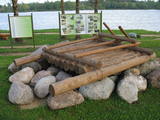 |
Plavinas and Stukmani region was inhabited already in the third century. During the Polish-Swedish War (1600-1629) at estuary of Aivekste in the Daugava River the Swedish war camp was formed, from which are preserved fortifications - bastions. They are one of the most impressive military formations of this kind in Latvia. Plavinas as a larger populated area started to develop in the nineties of the 19th century and in the beginning of 20th century after the construction of railway. Today Plavinas are more commonly known with dolomite production sites and spring flood area. |
|


