
| No | Name | Description |
|---|---|---|
 |
The private museum of antiquities of Zigurds Safranovičš was founded in May 2010. The collection of the museum contains around 50 thousand objects, of which 99% of exhibits have been donated. The oldest and rarest, according to legend, 300-year-old item – Ernst Glick's refrigerator. The museum's surroundings are a large park of the former Baron Wulf's estate, where it is currently possible to spend the night in tents, as well as available rest areas - canopies, fire places, grills, utensils for cooking, etc., drinking water (from a well), available electricity for telephones, cameras, etc. for charging. For larger groups (starting from 10 people), porridge cooked on the fire. |
|
 |
The café is at the edge of the Cēsis-Valmiera road. It is in a log building with a Latvian interior design. Vegetables and fruits are bought from local farmers. Latvian cuisine: Crepes, potato pancakes, cold soup, wild mushroom soup, sorrel soup according to a recipe from granny, porridge, grey peas, baked herring, filet of cod, beef sautéed in Brenguļi beer, sautéed rabbit, stacked rye bread. Special foods: "Glendeloka". |
|
 |
An organic farm where it is possible to read and taste strawberries directly from the field during the season. There are also real wild strawberries. Sea buckthorn is also grown, can be read and tasted in September. Small-scale processing (juices, syrups, frozen products, jams) - home producer status. |
|
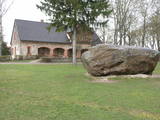 |
The museum is in the Lielvārde Park. It is in the granary of the Lielvārde Estate that was built in the early 19th century. It was later used as a residential building. A veranda was added to it in 1922. The museum has been there since 1970, and it features exhibits about the Latvian national epos “Lāčplēsis” and its author, Andrejs Pumpurs (1841-1902). The museum also features information about the history and ethnography of the Lielvārde Administrative District. Alongside it is a large rock that weighs around 80 tonnes and is known as Lāčplēsis’ Bed. A broken part of the rock is known as the Lāčplēsis blanket. Both rocks were once on the banks of the Daugava River next to the Lielvārde island. Waters from the Ķegums hydroelectric power plant now make waves in that area. Nearby is the so-called Spīdala log that was brought from Aizkraukle.
|
|
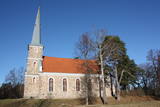 |
A wooden church was built here in 1766, and the new brick church was built on the foundations of the old church and consecrated in 1868. The tall steeple of the church helped ship captains orient themselves during the daytime. An altar painting by Gunta Liepiņa-Grīva, "Christ and Peter on the Sea," was consecrated in 1993 to replace the former painting, which was lost. The blue-white-green Livonian flag was consecrated at the Mazirbe manse (now a recollection centre) on November 18, 1923. Near the manse are several rocks which stand witness to the Black Plague in 1710 and 1711. The text in Latin said that Livonians on the coastline were conquered by Swedish King Karl IX and the bubonic plague. The texts on the rocks have eroded away, but records of them were made. The Mazirbe cemetery has a monument to Old Taisel, a monument to the parents of captain A. Bertholds, and the legendary grave of a werewolf. |
|
 |
Iespaidīga smilšakmens atsegumu virkne, kas
izveidojās pēc 2005. g. orkāna.
|
|
 |
Cheese farm Andre manufactures and sells globally renowned cheeses. Cows from happy farms give premium quality, delicious milk. Farm visitors can visit and see the cows, as well as watch the milking process. You can buy organic cheese and other organic local produce from small producers at the small farm store. |
|
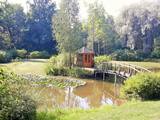 |
One of the oldest botanical parks in Lithuania, this one was opened by Izidoras Navidanskas in 1928, when he was only 16. In 1965, the park because the Žemaitija botanical park, and Navidanskas and his son, Rapolas, who is the current owner, did a lot to expand it. |
|
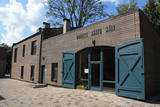 |
The Dobele Crafts House is to the East of Market Square at Baznīcas Street 8 in Dobele. Enthusiasts use it to preserve ancient traditions from the Zemgale region. Workshops to teach crafts are organised here five days a week. |
|
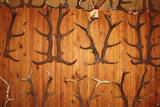 |
Found at the Purvziedi homestead in Vaide, this collection of more than 600 horns has been established by forest guard Edgars Hausmanis, who says that he found all of the exhibits in the forest. |
|
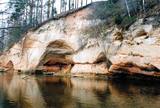 |
This is one of the most beautiful ancient river valleys in Estonia – 12 km long with nearly 40 revealed Devonian sandstone cliffs. Among these, the most important ones are Viira müür, Kalamatu müür, and Põdramüür.
|
|
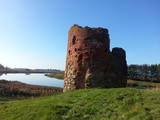 |
Piltene is one of the smallest and oldest cities in Latvia, first mentioned in 1295, and being granted the rights of a city in 1557. Between the 14th and 16th century, Piltene was the administrative centre for the Bishopric of Kurzeme. The historical streets that surround the castle ruins feature wooden buildings from the first half of the 19th century. The bishop’s castle in Piltene was built at the turn of the 14th century and used until the 16th century. Only its foundations and fragments of its tower on the banks of the Vecventa River survive. |
|
 |
The Ķemeri school was built in 1934 (architect
Kārlis Cināts). It is one of the few school buildings in
Latvia to have preserved an historically valuable interior
and exterior, including allegorical images on the façade.
|
|
 |
The chef's house is located in the former Līgatne Maternity Hospital "Wilhelma". It is intended as a place for chefs as well as other interested parties to do, create and experiment. The author of the idea is chef Ēriks Dreibants. The aim of this place is to encourage you to explore and discover the unique tastes and experiences of our region. The chef's house supports the slow food philosophy and the surrounding farmers and producers. Next to the house there is a Nature Observers' Garden, where there is a playground "Nest in the Tree", a magnifying glass for a closer look at the elements of nature, and a picnic area with a fireplace. There is an herb garden in the garden, fruit trees and berry bushes have been compiled, but in the center of it, next to the Bird Watching Square, there is a Butterfly Meadow. |
|
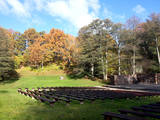 |
features an open-air stage in a lovely place. During the summer there are concerts, theatrical performances, parties, Summer Solstice celebrations, etc. The International Bourdon Festival is held once every four years, and the next one will be in 2020. This brings together bourdon singers from many countries in the world. |
|
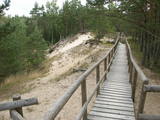 |
The trail climbs up and down along the bluffs of lower River Pilsupe and reveals a fascinating sight of three white dune exposures (the largest is called the White Dune). The trail is 900m long, and the White Dune is ca 20m high. It has formed ca 6000 years ago, in the period of the Littorina Sea which is a foregoer of the Baltic Sea. Here the first Stone Age settlement on the North Western coast of Latvia has been found in 1934 by geologist S. Burhards. In the sand, some 500m from the sea, he found some pottery fragments, a sandstone hone, a piece of flint, parts of bones and an amber bead. He handed the findings over to the National Museum of History. In October 1934, the site was checked by archaeologist E. Šturms, who found the archaeological layer, typical for such settlements, in the landslides of the Pilsupe riverbanks. In 1936 he started larger excavations to continue by 1938. Totally seven, chronologically different settlements were detected and many artefacts found, including fragments of the so called Sārnate and pit-comb pottery, as well as some pieces of corded pottery. Based on these findings, the settlement is dated back to the beginning or middle of the 3rd millenary B.C., and it has been inhabited till the beginning of the 2nd millenary B.C. Especially remarkable are three clay figures in human shape which have probably been used for some religious cult purposes. Since 1993, archaeologist Ilzes Loze has discovered several pit-comb ware culture settlements in large area around Pūrciems village. They are known in research literature as „the Ģipka settlements”. |
|
 |
The saloon is on the corner of two historic roads – the Rīga-St Petersburg road and the Cēsis-Vecpiebalga-Madona road. It uses ingredients from local farms and vendors. Latvian cuisine: Grey peas with bacon, dumpling, beet or wild mushroom soup, bean salad, herring with boiled potatoes and cream, farmer’s ramekin, roast pork, potato pancakes, crepes, bread soup, strawberry dessert, homemade ice cream. |
|
 |
Here you will find a ceramicist who offers educational activities during which you can shape your own items and then put them in the kiln. The studio welcomes kindergarteners, schoolchildren, adults and senior citizens. The ceramicist has experience with people with special needs. Finished clay products are available at the studio.
|
|
 16 days
|
This grand hiking tour is provided for experienced hikers wishing to walk along a large part of the coasts of Latvia and Estonia, gain a detailed impression about the diverse coastal landscape, nature, birds and animals of the Baltic Sea. The Baltic Coastal Hiking Route sometimes runs through sandy beaches, sometimes along sections of beach covered in stones and pebbles. Sometimes the trail goes through coastal forests or stops at a fishermen’s village. There are many floodplain meadows, lagoons and shallow bays on the Estonian side, so sometimes the path goes along coastal trails and roads. In the end section of the route you will feel Estonia’s Nordic nature more. Part of the route runs along a sparsely populated seashore where you can be alone with yourself, but you will also be able to visit the most prominent cities. You will visit both capitals: Rīga and Tallinn. Enjoy the hospitality of the resort towns of Jūrmala, Pärnu and Haapsalu. During the hike, you will also get acquainted with the regions of small ethnic cultures: the Livonians in Latvia and the inhabitants of Kihnu in Estonia. |
|
 |
Saimnieks nodarbojas ar biškopību un apmeklētājiem piedāvā ekskursiju pa saimniecību, stāstījumu par bitēm, medus degustācijas. Iespēja iegādāties pašdarinātas vaska sveces un citus biškopības produktus. |
|


