
| No | Name | Description |
|---|---|---|
 |
The restaurant is in the Park Hotel Latgola with a broad view of the city from the 10th floor. It offers Lettigalian and global cuisine. |
|
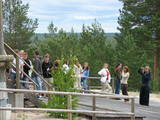 |
The word “Luitemaa” means “land of the dunes” in Estoninan. This coastline territory stretches for 13 km between Vöiste and Häädemeste with shallow waters, large coastal plains, Estonia’s highest dunes, and the Tokuse swamp (Tokuse raba). There are lots of birds here.
|
|
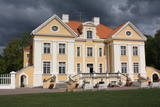 |
Palmse Manor is known to be considered as one of the most beautiful manors in Estonia. The manor has been mentioned first in 1510 as a property of women's monastery. In later centuries it belonged to Palenu family. Manor was built in 1697 but it was made the way we see it nowadays in 18th century. It has been renovated one more time in 1970-1980's. Around the building is a big and scenic park with several ponds. Inside the manor you can become familiar with its interior and visit the basement as well as buy Estonian wine. |
|
 |
Ein einzigartiges Örtchen beiderseits des Flusses Minija, wo der Fluss eine „Hauptstraße” ist. Litauens Venedig. |
|
 |
The private museum of antiquities of Zigurds Safranovičš was founded in May 2010. The collection of the museum contains around 50 thousand objects, of which 99% of exhibits have been donated. The oldest and rarest, according to legend, 300-year-old item – Ernst Glick's refrigerator. The museum's surroundings are a large park of the former Baron Wulf's estate, where it is currently possible to spend the night in tents, as well as available rest areas - canopies, fire places, grills, utensils for cooking, etc., drinking water (from a well), available electricity for telephones, cameras, etc. for charging. For larger groups (starting from 10 people), porridge cooked on the fire. |
|
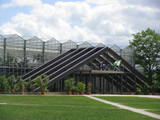 |
The National Botanical Garden in Salaspils ranks as the largest botanical garden in Latvia and in the Baltics with a territory of 136 hectares. The National botanical garden collection consists of about 14 thousand different varieties. More than 5,000 plants are found in the arboretum, as well as various other exhibitions, such as orchards, rosaries, ornamental plants. Botanical Gardens can inspire you to uprade your own garden assortment with new plant varieties and offers the experience of learning about botanical knowledge in nature. In addition, it presents opportunity to expand your personal photo archive with an exclusive background photographs and close-ups. There is a playground for children, comfortable cycling paths, nordic walking paths, picnic possibilities. |
|
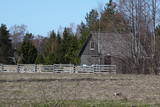 |
This village appears in historical documents from 1310. A census in 1582 and 1583 recorded eight farms in the village, while a 1731 census conducted by the Dundaga Estate found only three. In 1826, each farm had 16 or 17 people, with some 60 in total. A census in 1935 showed that all 49 Livonians in Saunags spoke the Lithuanian language, but only 11 of them spoke the language at home. There was a store that was owned by Kārlis Tilmanis, who also owned a factory where sprats were salted. Also born in Saunags was the seafaring captain Arvīds Ludeviks (1912-1996). In May 1945, he captained a tugboat, the Rota, in an attempt to bring Latvian refugees to Sweden. The ship was detained, and the captain was sent to Siberia. Another seafaring captain from Saunags was Visvaldis Feldmanis (1938-2017). |
|
 |
This is a farm where there are some 10 different kinds of strawberries on many hectares of land. Anita Rescenko offers a six-day strawberry cure to improve your health. Pick and taste strawberries, purchase them fresh and clean. There are strawberry masks, dishes prepared with strawberries, clay masks and compresses against joint pains. Visitors can learn flower arranging, boat around the local lake, etc.
|
|
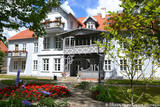 |
The Šilute Estate is often described on the basis of its last owner, Hugo Scheu, who bought the estate in 1889. He restored the estate's buildings and territory, also installing two parks, one for the estate, and the other one known as the "raven forest." Alongside the estate is an English-type park with strolling trails. The park is used by local residents and is on both sides of the curvy Scheu River, with the banks connected by pedestrian bridges. He park stretches to an old railroad bridge and has approximately 150 types of plants, including 40 types of trees and shrubs. |
|
 |
This is an unusual farm, one with no electricity (its owners use candle lanterns and petroleum lamps), with all work done by hand. Visitors can watch the milking of goats, the subsequent handling of milk, and the production of cheese. They can help to harness horses, try out sleds on wheels, and work with a scythe and a sickle. Livestock raised in the Latvian countryside can be viewed. |
|
|
|
Die älteste (16 Jh.) der drei Burge am Fluss Nemunas. Renoviert nach dem 2. Weltkrieg. Heutzutage – eine Schule. Ein Park. Blick vom Burgturm. |
|
 6 days
|
The Baltic Sea littoral on the West coast of Kurzeme is called the Great Wave Sea. The seacoast is mainly sandy. While the Great Wave Sea section is the least populated coastal area in Latvia, at the same time, the third biggest city in Latvia, Liepāja, is also located there. Steep bluffs rise before your eyes on the seacoast between Pāvilosta and Sārnate. The villages are quiet and sparsely populated. At the beginning of the route, you can see the Soviet military heritage in Liepāja Karosta Prison, taste smoked local fish in Pāvilosta and then enjoy one of the most beautiful views of the entire route to the seacoast from Užava lighthouse. The route closes in the port city of Ventspils, where there are various entertainment and sightseeing places, especially for families with children. |
|
|
|
Taka ap Ozolu Mazezeru. Purvaino krastu posmā, ap ezera rietumu galu, ierīkotas gājēju laipas. Novērojami purva, meža un ezera augi, dzīvnieki un biotopi. Jūlija beigās īpaši krāšņi zied ūdensrozes. Blakus atrodas Ozolmuiža ar parku.
|
|
 3 days
|
This part of the Forest Trail gives an opportunity to see Setomaa or “the Land of Setos” which is inhabited by Setos – an ethnographic group with specific ancient traditions and a unique language dialect. Forest Trail hikers can visit the traditional Setos homestead and enjoy Setos cuisine. The forests of the region are especially charming in early autumn, when the ground is coloured lilac by the blooming heather. There is a good chance to pick wild mushrooms and berries. One of the most beautiful sections of this trail in Setomaa leads along the River Piusa, where the river is surrounded by sandstone outcrops. You will also visit the Piusa caves. The tour will end in Värska resort – with its sanatorium and SPA, which use the strengths of local nature: mineral water and lake mud. Värska mineral water is well known in Estonia and elsewhere. |
|
 |
The “Lamb Club” is a farm in Mazsalaca, and it is special because the sheep live in a real club! The owners offer the atmosphere of a farm at which the sheep play major roles. Enjoy mutton and sheep milk foods and beverages, feel how comfortable it is to read your favourite while sitting on a fluffy sheepskin, and, in order not to get cold by the campfire in the evening, you can purchase warm woollen socks and woven woollen cloaks. The owners hope that people from Latvia and all around the world will spend more time at the farm, because accommodations involve a new glamping tent that is as close as possible to nature and the healthy rural environment. Don’t lose a lick of the comfort that you are used to in your everyday life! The owners, Ilze and Valters, will be happy to give you a tour during which they talk about herding sheep. If you contact them in advance, they will prepare a tasty mutton meal for you. The tour can also be supplemented with various activities such as games, quizzes and creative workshops at which sheep wool is utilised. |
|
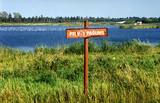 |
A restricted area with a set of artificial ponds to the South-west of Saldus. The ponds attract many different kinds of birds during nesting and migration season. The location has not been improved for tourist purposes, but it is still an interesting place for some bird-watching. The forests around the ponds are also home to many protected birds and species of bat. |
|
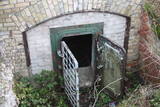 |
The so-called Comet Fort was built on the Left Bank of the Daugava at its mouth, not far from the present Daugavgrīva lighthouse. It was built around the same time as the other forts of Mangaļsala (around 1808, although some sources say 1788). There were four Kane-type 152-mm cannons. The defensive batteries at Komētforts and Mangaļsala repelled a British naval attack in the Daugava estuary in 1855. It has to be added that Komētforts is a cultural monument of local importance. If we go along the shore of the sea from the Daugavgrīva nature reserve toward the Daugavgrīva lighthouse and scale the frontal dunes (without going past the sign which says “Closed Territory. Border Zone.”), then we can see the positions of the cannons, as well as underground cellars where munitions were once stored. The territory starts approximately 500 metres before the Daugavgrīva lighthouse and stretches to the lighthouse itself. During Soviet times, the territory was closed to civilians, because many secret military objects were in this area and in Bolderāja.
|
|
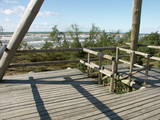 |
The Grey Dune of Pāvilosta nature reserve covers 42 hectares of land and has been designated to protect Latvia’s widest dune (1.5 km parallel the seacoast, and 812m in the direction from the sea to inland) and the biotopes and species found there. A two-storied watching platform is built to savour the scenery. In Soviet time, local fishermen used to dry seaweed in dunes for production of agar, and thus rich vegetation developed in the dune. The Gray Dune is part of a unique landscape with the sea view, the traditional architecture of Pāvilosta fishing town, and biotopes, including protected, which border the nature reserve: pine forest, embryonic dunes, white dunes, and wet beech where once can find springs. Biotope 2130, “Fixed dunes with herbaceous vegetation (grey dunes)” is found here. At present, pines are taking over the biotope, therefore some maintenance activities are required. The Grey Dune is most beautiful in the second half of July and in August when the blossoming Breckland Thyme (Thymus serpyllum) and Narrowleaf Hawkweed (Hieracium umbellatum) colour the dune in shades of yellow and violet. The most typical species here are Pasqueflower (Pulsatilla pretense), Grey Hair-grass(Corynephorus canescens), Blue Hair Grass (Koeleria glauca), Sand Pink (Dianthus arenarius). The Gray Dune earned wide recognition when a group of enthusiasts actively campaigned for six years to achieve the status of the nature reserve. Guna Grimsta, a group representative remembers that they organised events and activities throughout Latvia involving large part of the society, prominent personalities, church parishes, NGOs, school youth and university students. The activists were writing letters, making videos, doing research articles, composing music, collecting signatures and submitting proposals to achieve official status of the Grey Dune as an especially protected nature site. They organised seminars, concerts, art plenaires and exhibitions, educational excursions, joint-work, musical church services, meetings with high officials and their on-site visits to the Gray Dune. In 2006 the group received the title „Proudness of Latvia” awarded by the national TV3 broadcasting company and daily paper „Diena”. |
|
 |
Cafe Vizbuļi atrodas Bērzciemā, Engures novadā, apmeklētājiem piedāvā nobaudīt gardu maltīti, svaigi ceptas smalkmaizītes, izbaudīt Bērzciema jūru, atpūsties un relaksēties. Ziemas sezonā kafejnīca atvērta tikai nedēļas nogalē, vasaras sezonā - katru dienu, ir āra terase. |
|
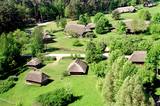 |
Countryside life open-air museum. Various historical county buildings, everyday life tools, traditions etc. |
|


