History
How long have Latvians been familiar with butter, cheese and other dairy products?
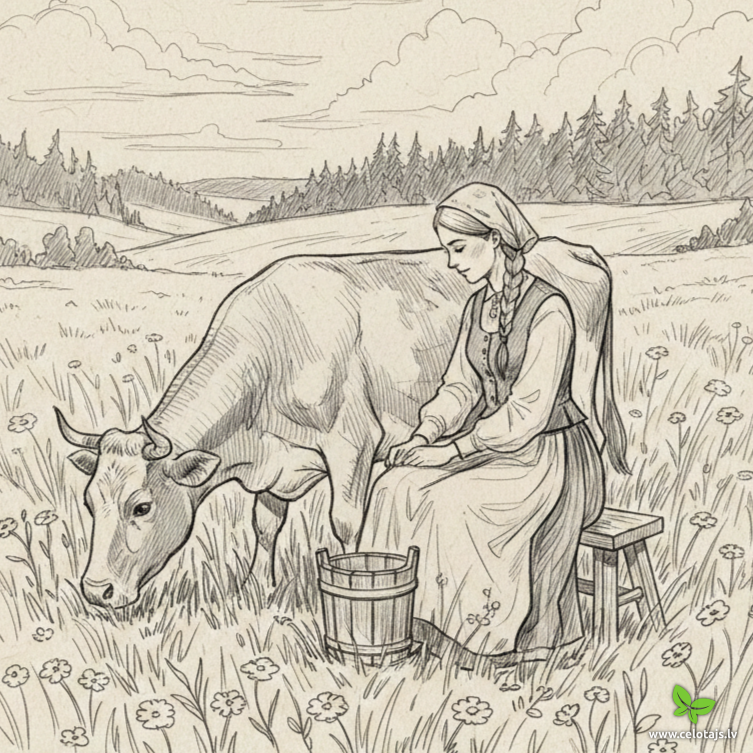
I had a brown cow
That offered lots of milk
I produced cheese every day
And churned some butter, too.
(Latvian folk quatrain)
The Chronicle of Indriķis (early 12th century) reports on Germans who pillaged Courlandian villages, and this contains the news that they stole five barrels of butter, two kegs of beer, 40 large loaves of bread, two tanned cow skins and other household objects. From this simple list we can conclude one thing – Latvians didn’t learn about how to churn butter from the invading Germans.
Linguistic evidence about cheesemaking traditions

The most ancient evidence of cheese in Latvia is found in historical sources and in the oral traditions of the Latvian people, particularly in terms of the Summer Solstice. The oldest word registered in Latvia’s present-day territory in relation to cheese is “jauns siers” (novus caseus), which was cited in Georg Mantzel’s 1638 dictionary. He also listed the term “knead milk to get butter,” which means the preparation of cottage cheese.
Later, in the late 18th century, pastor August Huppell in Vidzeme wrote about “Latvians who prepare large cheeses with eggs,” which means that the tradition was already and firmly in place. In 1852, Kārlis Lepevičs published a cookbook for farmers which included a thorough explanation of how Summer Solstice “Jāņu” cheese is made.
The Baltic and Finno-Ugric languages show that the words siers / sūris / sõira / syr are regional variations within the same linguistic context as the Lithuanian sūris, and appear historically as long-established, everyday terms.
In historical terms, these have been presented as everyday terms from antiquity, which supports the idea that dairy processing, including the making of cheese, was quite well developed in the region at that time.
It is interesting that the word sõira in the Livonian language means “cheese,” and this is one of the most ancient documented borrowings between the Livonian and the Latvian languages.
The oldest cheeses

Ancient dairy farmers always faced the problem of what to do with surplus milk. This is where dairy processing and cheesemaking first began. In historical terms, the problem first affected people who lived in warmer climes, and that is why cheesemaking traditions first emerged in countries which are known for their cheeses today – Spain, France and Italy.
The first cheeses in Latvia were so-called sour milk cheeses (or lactic cheeses). Someone accidentally warmed up curdled milk, and the result was an early version of cottage cheese. When the curds were separated from the whey and the resulting cottage cheese was dried, that led to the first sour milk cheese.
Curdling milk with calf rennet appeared much later, but developed very quickly when German aristocrats in Latvia hired cheesemakers from Germany and Switzerland to work for them.
Local cheesemakers eventually joined the staff at countryside manors, and this was seen as a very respectable profession, indeed.
Castles and noble estates, 16th to 19th century
 Between the 16th and 19th century, dairy processing at noble estates was very common. Nearly every larger estate had a dairy facility to produce butter, cream and milk for household consumption, but also as something that could be sold to others.
The concept Meierei (German dairy) often appears in inventory lists and landbooks from the estates.
The head of each operation was a Meier – someone who oversaw dairy farming, herds and dairy processing.
Sometimes the work was done by a Meierin/Milchmeisterin – a woman who played the role of cheese and butter master.
Here are a few terms that often appeared in the relevant documents:
- Käsemacherin (cheesemaker)
- Milchmeister/Milchmagd (dairy master, dairy girl)
- Butterei/Meierei (dairy)
19th century estates in Kurzeme and Zemgale had highly developed production of butter and cheese, with German, Dutch or local cheesemakers doing the work. The Bērzu Estate, the Vecauce Estate, the Jaunpils Estate and the Jaunauce Estate all had dairies to produce butter and cheese that was delivered to Rīga and exported abroad (as documented in Latvian State Historical Archive, Fund 6839., 7021., etc.).
Late 19th to early 20th century
- Noblemen sent local masters to train in cheesemaking in Switzerland and Germany, particularly after dairy farming courses (Meiereischule) were organised in the Kurzeme province of the Russian Empire;
- Dairy farming schools in Jelgava, Valmiera and later also in Rīga trained local cheese and butter masters between 1880 and 1910.
The archives of estates include the words Käse, Butter and Rahm as output units.
The cheesemaking traditions of the noble estates led to the emergence of sweet milk semi-hard and hard cheeses that are much different from the traditional Summer Solstice cheese of the farming community.
Early 20th century, independent Latvia
- Agricultural reforms and redistribution of land holdings in Latvia after it declared independence allowed farms to become larger and dairy farming in particular to flourish;
- Dairy co-operatives emerged with dairies working together to produce milk and various processing equipment;
- The first cheesemaking operations appeared and began to produce gourmet cheeses that were eventually exported, mostly to countries in Europe.
| 1900 – 1920 |
Local dairy co-operatives in Vidzeme (Trikāta, Smiltene, Cesvaine, Limbaži). |
| 1920 – 1930 |
Trikāta, Valmiera, Rūjiena, Smiltene, Jelgava, Limbaži. |
| 1930 – 1940 |
Major export achievements. Latvian cheeses that were exported to England and Germany won much praise for their high quality and pure flavour. |


Interesting facts about cheese back then


During the first period of Latvia’s independence, several books were published about how to make cheese. The books offered lots of information about cheeses from all around the world, encouraging locals to develop a sector that was as tasty and successful as was the case in countries that were famed for their cheese industry.
“’Knappsier’ is a name which shows that the birthplace of cheese was probably in Germany. This is a cheese that is used as a snack to accompany alcoholic beverages, but it also is tasty in a sandwich or when drinking tea or coffee.” (“The Little Cheesemaker”, 1927)
“High-quality cheese requires the best quality of milk. The taste of dairy products will, as everyone knows, depend on the amount of milkfat found therein, but the success of cheesemaking will be less dependent on the components of the milk as on the many different desirable characteristics of milk.” (“The Little Cheesemaker”, 1927)
“The best cheese is made during the summer, when livestock are in the meadows. Sensible feeding and sanitation during the winter, when the livestock are in the cattle barn, ensures milk that will be of good use for cheesemaking.
“Fresh milk will not do for cheesemaking, because the milkfat bacteria must be given time to mature. That will be particularly true when it comes to hard cheeses.” (“Little Cheesemaker”, 1927)
“The appearance of Roquefort cheese is a completely new thing in Latvia [article from 1930]. Work on producing such cheese began in 1920, though there were a few attempts at it earlier than that.” (Richters, ‘The Smiltene Joint Dairy’), “Cheesemaking”, 1930)
The Soviet and Nazi occupations
During and after World War II, Latvia’s cheese sector underwent fundamental changes due to the German occupation (1941-1944) and the Soviet occupation (1944-1990).
1941-1944: During the German occupation, cheesemakers were subject to the Reichskommisarriat Ostland administration, which covered the territory of Latvia. Larger dairies in Trikāta, Jaunpils, Limbaži and Jelgava continued to produce cheese, mostly of the Holland, Tilsiter and Zemgale types. Exports were limited, as most output was consumed in the local market or delivered to the German military and administrators.
1944-1990: After Latvia’s occupation and annexation by the USSR, larger dairies were nationalised and merged into combines (the Rīga Milk Combine, the Jelgava Milk Combine and the Jelgava Dairy Combine). These became the primary producers of cheese. The whole process was centralized and standardised, the focus being on popular types such as Holland and Russian types, as well as cottage cheese. The standardisation was subject to national planning requirements, with little thought given to flavour or to cheese as an exclusive foodstuff. Exports were based on the Soviet planned economy, with most of the cheese that was produced in Soviet Latvia being sent to other Soviet republics, especially Russia, Belarus and Ukraine. Precise export data are not available, but it has been thought that as much as 90% of Latvia’s dairy output was shipped out to other Soviet republics.


Cheese in Latvia since the restoration of independence
| 1991 | Launch of privatisation. |
| 1991 - 1999 |
Stabilisation of new farming methods, strengthening of ownership rights, and the first move toward modernisation. |
| 2000 - 2010 |
Development of manufacturing, focus on exports, integration with the EU, improved quality and the first experiments. |
| 2011 - 2021 |
Emergence of cheese niches and flourishing of new (or long forgotten) types of cheese. |
| 2022 - 2025 |
Recovery of the sector in the wake of Covid, with cheese turning from an everyday product into a bearer of culinary heritage. |
| Šodien |
The Path of Cheese: New links among manufacturers, culture tourists and gourmands. |
1991: Independent Latvia
After the restoration of Latvia’s independence, the dairy industry and its cheese industry went though a fundamental transformation that involved privatisation, consolidation, modernisation (integration into the EU), development of manufacturing, and a new focus on experts. In addition to improved results for the relevant companies, manufacturers of niche and gourmet cheeses began to appear during the 2010s.

1991 - 1999: From collective farming to a market economy
During the 1990s, cheesemaking in Latvia was basically focused on survival during the transfer to a market economy. Companies continued to offer cheeses from the Soviet period, while the emergence of new styles or artisanal cheesemakers was not yet possible because of economic and social problems.
- Privatisation: In the wake of restoring independence, Latvia abandoned the centralised Soviet system of manufacturing and planning and instead introduced a market economy. Initially this was done with any real capital, stable sales and destroyed logistics – something that had a directly deleterious effect on the whole sector.
- Greater efficiency was the key from 1994 until 1997. The dairy industry that had been state-owned was privatised, although in retrospect, not without mistakes and various opportunists who emptied out the budgets of companies that were already in sad shape. Some companies underwent consolidation, some were bought by foreign investors, and that enabled the emergence of the first powerful players in the new economic system.
- Quality and movement toward the EU were keywords between 1997 and 1999, with cheesemakers introducing EU food purity requirements, as well as new technologies. More thought was given to packaging of products. Cheesemaking was basically focused on domestic consumption. Several companies gained independence – Valmieras Piens in 1993, the Jaunpils Dairy pienotava in 1997, and the Smiltene dairy piens in 1998, all of them becoming joint stock operations which made it possible for the operations to find new foundations with independent decision-making and more control over output.
- During the 1990s, cheesemakers focused on traditional products such as cottage cheese, the classic Holland and Tilsiter types, butter as well as soured milk products. Not much diversity in this process.
The largest and most important companies during the 1990s
| Rīgas piena kombināts (The Rīga Dairy) | Continued to produce Soviet-era Holland and Russian-type cheeses. |
| Valmieras piens (The Valmiera Dairy) | One of the most important dairies in the Vidzeme region, focusing on classical cheeses and cottage cheese. |
| Smiltenes piens (The Smiltene Dairy) | A wide range of dairy products, including milk, kefir, butter, cream and cottage cheese. Most of the company’s output (70%), however, is various kinds of cheese. |
| Jaunpils pienotava (The Jaunpils Dairy) | Preserved operations and offers of cheese, butter, cottage cheese and soured milk products. |
| Trikātas pienotava (The Trikāta Dairy) | The company maintained its traditions, but output dropped in comparison to the period before the Soviet occupation. |
| Small Dairies in Jelgava | Most focused on fresh milk, but with cheese also on offer. |
2000-2010: The path of cheese from survival to excellence
This was a decade during which cheesemaking moved from the period of post-Soviet survival into a path of high quality, standardisation and gradual differentiation of products, thus preparing fertile ground for the development of artisanal cheeses.
- The approach toward the European Union and the resulting shift in standards had a key effect on the cheesemaking sector. Several small dairies that had out-of-date technologies were reorganised, shut down or merged with larger companies.
- Companies made investments in new facilities, monitoring of quality and design of modern packaging.
- EU food safety and hygienic standards (HACCP, trackability) were adopted.
- The production of industrial cheeses became stronger, dominated by semi-hard cheeses with:
- Anticipatable technological processes.
- Predictable taste, aroma and storage terms.
- Larger volumes of output
There were few experiments with flavour during this period:
- Exports were renewed and the market was expanded. After 2004, Latvian cheese was sold in the EU, where export was largely based on competitive prices, but for the time being, nothing unique represented a true story about Latvia.
- The emergence of consumer culture meant that people increasingly travelled and dined at restaurants, which encouraged greater interest in global cheeses and meant new demand for the most interesting products in the cheesemaking sector.
- Companies focused on the recognisability of their sector, and in 2002, the “Cheese Club” organisation was established.
- Although at the beginning of the 2000s niche cheese production could not yet be regarded as a separate sector, its foundations were being laid. Companies were experimenting internally and on a smaller scale with cheese recipes from around the world and new flavours, going on training trips and developing an understanding of cheese maturation as a value in its own right.
Industrial cheesemaking became stronger during this period, and exports were renewed. Consumer tastes gradually changed, creating prerequisites for the artisanal cheese movement during the next decade.
2010 - 2021: From cheesemaking to identity

Latvia’s cheesemaking sector is continuing to increase its production volume, which has nearly doubled since 2009. In 2009 the amount of cheese produced was about 29,000 tonnes, compared with around 56,500 tonnes in 2023, indicating stable growth over a longer period.
According to Lursoft data, in 2021 there were approximately 55 dairy processing and cheese-producing companies registered in Latvia, including both large industrial producers and smaller enterprises.
- Companies are actively introducing new products into production, now also targeting the gourmet niche. Cheeses such as Granister, Monterigo Grand Duro, Smiltene and others produced with long, patient maturation technologies are appearing on the market.
- The accessibility of global dining culture enhanced demand, with consumers seeking not just everyday cheese, but also cheeses that have a wealth of flavour for the celebration table.
- In 2015 Jāņu siers (Midsummer Solstice cheese) was included in the European Union’s Traditional Speciality Guaranteed (TSG) register.
- During this period, competition among producers increased, and with it an emphasis on quality.
- In 2020 – 2021 The Covid-19 pandemic temporarily affected the dynamics of the cheese sector in export and in the catering and foof service industry.
- Export volumes declined as restaurant operations decreased both in Latvia and abroad.
- At the same time, domestic consumption of the cheese and cottage cheese (biezpiens) remainded stable, but industrial cheeses intended for everyday use continued to dominate.
2022 – 2025: Stability. Craftsmanship. Flavour
 Overall growth and stabilisation in the dynamics of cheesemaking
- In 2013, the production of dairy products, including cheese, increased by ~24% in 2023, as compared to the previous year. Cheese output rose by ~17% in comparison to the previous year. This indicates the strong recovery and increased volumes.
- Overall milk processing increased in 2024, including cheesemaking, which meant a stable output level and the preservation of industrial products.
- During the first half of 2025, output of dairy products, including cheese, grew by some 13-14% in comparison to the previous year, thus continuing growth.
Export – New Markets and Minor Fluctuations
- Cheese in 2024 was exported to more than 45 countries, including new markets in Vietnam and South Korea
- Cheddar exports shrank a bit to countries such as Germany and the Netherlands, but the export of fresh cheese and cottage cheese increased rapidly, particularly to Ukraine, Italy, the United States and Saudi Arabia
- Cheese exports rose gradually and stably from 640,000 tonnes in 2020 to more than 800 tonnes in 2024
Economic challenges
- The revenues of cheesemaking companies have grown, but profits have declined
- Russia’s war in Ukraine means that cheesemakers face higher costs
- Cheaper products are increasingly competitive, particularly when measuring strength with cheaper import products
Strengthening of gourmet and niche cheesemaking
Since the 2010s, alongside industrial production, small and medium-sized cheesemakers have solidified their position in Latvia, each focusing on unique cheeses in theor own way: Ievas siers, Rehtšprehera siers, Nīca siers, Sierštelle, SOIRA, Līcīši, and others
Small cheesemakers work with:
- Small batches
- Longer and natura cheese maturation
- Special recipes
- Local milk, often from a single herd
High-end restaurants and chefs actively seek out local cheeses and include them on menus, preferring domestic products over imports.
Cheese is becoming part of cultural heritage rather than just an everyday food product.
In Latvia, cheese is no longer merely an everyday food; it has evolved into a carrier of culture and culinary heritage, linking traditional dairy processing knowledge with modern gastronomic tastes and local identity. This development encompasses both artisanal and gourmet cheeses, as well as their integration into restaurant menus, where chefs increasingly use locally produced cheeses as a unique flavour element and part of the restaurant’s story.
A powerful example of this process is “The Cheese Route” project, launched in 2025 by the Latvian Rural Tourism Association “Lauku ceļotājs” together with cheese producers as a culinary tourism route and marketing platform. The project’s goal is to enhance the recognition and competitiveness of Latvian cheese by uniting producers for collaboration, knowledge exchange, and joint promotion to both domestic and foreign markets, while also offering stories, recipes, and tasting experiences to a wider audience. This initiative not only strengthens local cheese as an element of culinary heritage but also creates new connections between producers, cultural tourists, and gourmets.
The history of Latvian cheese was compiled by Inga Āriņa Vilne (cheese producer “Soira”).