
| No | Name | Description |
|---|---|---|
 3 days
|
Маршрут предусмотрен для опытных туристов, кому нравиться объединять наплюдения за природой с познанием культурной среды и истории. Это путешествие по самой впечатляющей речной долине в Балтии – древней долине Гауи. Маршрут начинается в Сигулде, которую с давних пор называют «Видземской Швейцарией». В окрестностях Сигулды открываются одни из красивейших пейзажей в Латвии. Маршрут пересекает глубокие овраги многих притоков Гауи и открывает внушительные в масштабах Балтии обнажения песчаника девонского периода. Природные тропы Лигатне – это единственное место в Латвии, где в условиях, максимально приближенных к естественной жизни в природе – в широких вольерах – можно увидеть разные виды диких животных. Поселок бумажной фабрики Лигатне – это великолепный пример индустриального наследия европейского масштаба со своеобразной средой поселка 19-го – 20-го веков. Цесисский средневековый замок – это мощная крепость средневековой Ливонии с современным центром для посетителей. Конечный пункт маршрута в Валмиере, одном из старейших городов Латвии. Информация о маршруте от Latvijas Lauku forums |
|
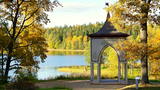 |
This landscape park dates back to the latter half of the 18th century, and its initiator was the owner of the Alūksne Estate, Baron Otto Hermann von Fittinghof. The largest park has important small buildings – the Alexander Pavilion, a temple honouring the Ancient Greek god of winds, Aeolus, the Palm House, a 1799 granite obelisk, the mausoleum for the noble family, a fountain basin that is made of a single piece of granite, as well as a set of granite benches. This is known as one of the most beautiful parks in Vidzeme. |
|
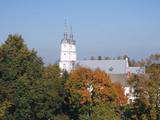 |
St. Michael the Archangel Roman Catholic Church of Viļāni. The Church together with the Monastery
of Bernardian Order was built in the middle of the 18th century. It is a national cultural monument. Many
important paintings, sculptures and objects of applied arts have survived here. The Church has an organ and
a fisharmony. The status of national importance was awarded to the architectural monument in 1952.
|
|
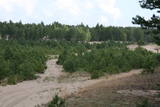 |
There are several large territories on either side of the Irbe River that were linked at one time by tank roads. Tank training and inspections were conducted here at one time, but now the territory has been abandoned and is slowly being reclaimed by the forest.
|
|
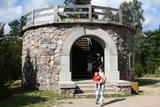 |
The tower is on one side of the range of hills known as Grantskalni (a continuation of the Blue hills of Ogre), and it offers a broad view of the Daugava River valley and the Pārogre residential district. The dendrology park that is nearby is worth a visit, because it is rich with different kinds of plants.
|
|
 3 days
|
The first half of this section leads through magnificent coniferous forests, especially in the Järvevälja landscape reserve, where the trail is surrounded by beautiful dunes in the north and a raised bog in the south. It is well worth visiting the kiosk at Rannapungerja to buy smoked fish – the Lake Peipus vendace (rääbis) and some local farm produce. In the second part, the Forest Trail winds along the coast of the beautiful Lake Peipus. During the summer, when the water level in the lake is lower, beautiful, sandy beaches with wide shallows appear. Past Alajõe, the highest dunes of Lake Peipus (up to 20 m) rise on the landscape, providing a distant view of Lake Peipus, one of the largest lakes in Europe. |
|
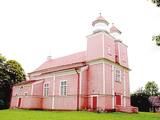 |
Located in the southern part of Feimaņi, the church was built between 1756 and 1760. The local estate was owned by the Korff dynasty, and the denomination of the congregation changed when the family converted from Lutheranism to Catholicism. This church has the largest number of artistic monuments among all churches in the Rēzekne Administrative District, including a confessional bench, pews, an organ prospectus, silver cups and three altar wood engravings from the 18th century. Above the gate is a bell tower with four bells. During Holy Week, clappers are used instead of bells. They are about 2 m long and 1 m high and are reminiscent of ancient laundry rolls. Feimaņi is also home to one of three flag workshops in Latvia, and it has state-of-the-art equipment. The flag of Latgale was “born” here in ideological and physical terms. |
|
 12 days
|
The tour introduces visitors to varied landscapes, local traditions and historic sites. Travellers are usually surprised that such a small territory holds so many contrasts. Riga offers a medieval Old Town and elegant Art Nouveau district, then comes Sigulda with three castles on the high banks of the Gauja river valley. Saaremaa island is a pleasure to drive around with good quality, quiet roads, windmills, medieval churhes and ethnographic villages. Tallinn has its walled Old Town while Lahemaa national park has an almost mystical landscape There is also elegant Palmse Manor. The tour goes through sleepy villages in eastern Latvia with distinctive pottery, ancient culinary traditions, and the Catholic pilgrimage site of Aglona. Vilnius' historic centre has distinctive baroque churches. The massive sand dunes of the Curonian Spit and Nida with its characteristic blue framed windows are among Lithuania's most attractive sights. Trakai has its picturesque medieval castle on the lake as well as the small Karaitis ethnic comunity with their unique traditions and food. Port towns Klaipeda and Liepaja have both developed into bustling modern cities with lively cafe culture. |
|
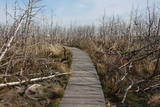 |
Nahe der Beerkopfdüne ist im Frühling 2006 „ein Brand der Jahrhunderte” gewessen. Es wurde der hundert Jahre alte Wald in der Fläsche von 235h ausgebrannt. Ein Pfad mit Holzbelag. |
|
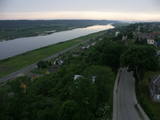 |
This park covers the Nemuna River valley between the villages of Seredžius and Geldaudišķis, with lovely views of castle hills, medieval castles, aristocratic estates, etc., along the shores.
|
|
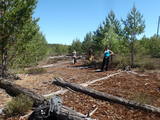 |
The Bažas swamp is the largest swamp in the Slītere National Park and is
entirely off limits to visitors.
|
|
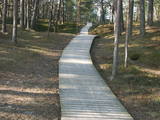 |
The nature reserve “Plieņciema kāpa” is founded in 1987 and covers 60.6 hectares of land. Since 2005 it is a Natura2000 site. The nature reserve protects a 150-200m wide and 3.5km long part of a distinct, continuous dune rampart. The dunes shelter Plieņciems village protecting from sea winds. The key natural values here are rare and protected biotopes of national and European significance: “Wooded dunes of the coast 2180” in the area of 61.8 ha, “Fixed dunes with herbaceous vegetation, 2130 (grey dunes)” in the area of 8.27 ha, “Shifting dunes along the shoreline with Ammophila arenaria (white dunes) 2120 in the area of 3.20 ha”, “Black alder swamp forests 9080”, ) in the area of 2,68 ha, as well as rare and protected species of Latvian and European significance including eastern pasqueflower (pulsatilla patens), Rolling Hen-and-chicks(Jovibarba sobolifera), Nothorhina muricata, Wryneck (Jynx torquilla), Woodlark (Lullula arborea). In the nature reserve, there is a “Vabu square” – a deflation in the dune where for centuries local fishermen have been drying nets. In the 18th and 19th centuries ships were built here. Nine ships have been built here in 1882 - 1925. The four-masted gaff-rigged schooner with hoisting engine “Eurasia” was completed in 1925, the largest ship built by the Kurzeme fishermen. It was one of the works of Martin Morgenstern (1866-1945), a famous shipbuilding master. Thanks to dunes, Plieņciems village was a popular holiday resort and has been mentioned in written sources already in 1738. Clergymen and landlords with their families used to stay here. In 1808, a merchant from Riga bought the local pub and replaced it with a massive two-storey building with a large ball-room and dining hall. On July 15, 1810, a sea bathing facility was opened for health treatment. For arrival of the empress Elisabeth Alexeievna, the wife of emperor Alexander I of Russia, who was a grandson of Catherine the Great, the road from Tukums town was repaired, the two highest hills were levelled, a road passage was dug across the Plieņciems dune, and a lime-tree alley was planted to facilitate access to the beach and bathing spot. Later, in 1920ies, the resort circles consisted mainly of the Kurzeme region landlords. There was a dance-floor in the park of Plieņciems village, and a special orchestra played music for resort guests three times a day. |
|
 |
Here you can watch ponies, donkeys, dwarf sheep, dwarf goats, dwarf rabbits, dwarf pigs, a llama, chickens and other fowl. Children can take rides with a pony or donkey, and they can feed fish in the local pond. There is a playground, along with a picnic location, “Paradise for dwarves.” |
|
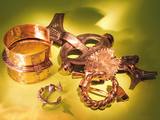 |
The Museum of Malta Secondary School No 2. Exhibition of the
ancient Latgalian jewellery of the 6th –13th century.
Working hours: Mon– Fri : 9.00 – 16.00, Sat., Sunday : closed |
|
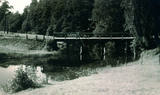 |
The River Pēterupe (46 km long) in its lower reaches flows by the sea, and it is one of the longest parts of the river along the picturesque coastline. In the past the River Pēterupe had several names: Pērļupe, Tarupe, Tara (in Livonian: the River of God or the Holy River). The historic area of Saulkrasti – Pēterupe Village was located on the right bank of the River Pēterupe. |
|
 |
A small beer brewery and shop in Lielvārde that organises tastings and offers to taste Latvian delicacies on-site and to purchase them for take away. |
|
 3 days
|
This tour will take you exploring the peculiar island of Rusnė and the delta of the river Nemunas in Lithuania. The island of Rusnė in the Nemunas Delta Regional Park is enclosed by waters of the river Nemunas and its tributaries. It is a resting place for migratory birds and home to a cormorant colony. The area of the island is 45 km2 and it is connected to the mainland by a bridge. The island of Rusnė is the lowest place in Lithuania, lying below sea level. The historic centre of the town Rusnė is characteristic of authentic wooden architecture, buildings painted in bright colours, colourful window shutters and decorations. The Baltic Coastal Hiking Route leads through the small town of Šilutė, revealing architecture that was once common to East Prussia. From Šilutė to Kintai, the Baltic Coastal Hiking Route runs along a low plain. To protect this area from flood waters of Nemunas, there is a system of dams, polders and canals established. After crossing the river Minija, the route invites you to visit the ethnographic village of Minija. Here you can enjoy the lowland landscape of the seaside region with vast wetlands and ponds. |
|
 |
Saimniecība nodarbojas ar zirgkopību un aitkopību. |
|
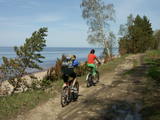 |
The largest NATURA 2000 territory in Latvia covers 6% of the country’s area. It is located in parts of the Limbaži, Valmiera and Valka districts, and it is a place of an enormously diverse range of landscapes, biotopes and species. The Salaca River is one of the most important rivers in the entire Baltic Sea region in terms of spawning grounds for salmon. The river valley and its sandstone cliffs attract many visitors. It is no accident that this is the second most popular river in Vidzeme for water tourism. The shore of the Bay of Rīga, which is not very long, also features a great diversity in landscapes and biotopes. At the northern end, we find the Randu meadows. In the central part there are sandy beaches, but at the southern end – 22 kilometres of rocky shoreline. The so-called Northern swamps are found on the border with Estonia, while the Seda heath is one of the most important places in the region for birds to rest and feed during migration. The reserve also features a diverse forest in which one can find all of the types of forest which are common in Latvia. Nature trails and viewing towers or platforms are found in the Randu meadows, on the banks of Lake Burtnieks, along the Planči and Niedrāji-Pilka swamps, on the banks of Lake Dziļezers and Lake Lielezers, and elsewhere. The Skaņākalns park in Mazsalaca is one of the most popular tourist destinations in Northern Vidzeme. The territory boasts many important cultural monuments, including one of the earliest known settlements in Latvia – a fishing settlement and burial ground which date back to the 5th to the 2nd millennium BC.
|
|
 |
The cafe is situated in the shopping centre Sala in Jekabpils, on the right back of the river Daugava. The cafe’s premises are comfortable and decorated with fresh flowers. It is a place where you can have either breakfast, dinner or supper. Working hours: 9.00 - 20.00 |
|


