
| No | Name | Description |
|---|---|---|
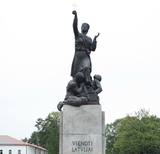 |
Located in the centre of Atbrīvošanas Alley, this statue is a monument to the liberation of Latgale and the unity of Latvia and is officially called “Unified for Latvia.” The bronze monument was unveiled in 1939 (sculptor K. Jansons, designer L. Tomačisks). In 1940, the Soviet regime tried to destroy the monument, but it was restored in August 1943. A second attempt to destroy the monument occurred in June 1950, and this time the process was successful. After the restoration of Latvia’s independence, “Māra of Latgale” was installed for a third time on August 3, 1992, sculpted by the son of K. Jansons, A. Jansons, on the basis of old designs. “Māra of Latgale” is one of the best examples of monumental sculpture in Latvia. Latvian mythology personifies the goddess Māra as a provider of fertility for earth and a protection of life. The cross that is part of the ensemble is a symbol of the Christian faith. |
|
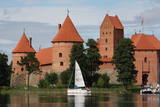 |
The Trakai Island Castle is the only East Europe's castle which is built on a little island. The process of building this castle started in 14th century. After its fall on 1410 during a war it lost its meaning as a military base and became a living place for ruler of Lithuania. Trakai Castle is one of the most popular objects in Lithuania for tourists. Inside the castle is a museum which tells about Trakai history.
|
|
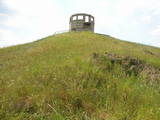 |
This unique territory covers more than 24,400 hectares, and the Soviet military used it as an aviation training centre. The history of the base dates back to 1951, when four kolkhozes were shut down, roads were closed, and several hundred farms and homes were simply moved elsewhere. A civilian presence at the base was restored only in 1993, when several new roads were installed. If you want to get a bird’s eye view of the base and its forests, you have to climb a high, manmade hillock from which commanders watched manoeuvres. We do not recommend that you wander off from the roads!
|
|
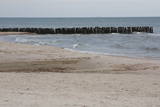 |
This is an enormously important territory for migrating birds. The most commonly spotted protected species of birds are the velvet scoter, the black scoter, the long-tailed duck, the little gull, the red-throated and black-throated loon, and the black guillemot. The territory is opposite the Dundaga and Ventspils administrative districts, and it covers 172,412 hectares.
|
|
 3 days
|
This programme allows participants to learn about Latvian ethnography and traditions through meeting local craftsmen and having master classes with them in knitting traditional mittens and gloves, making amber jewellery and cooking traditional foods. There is chance to have a unique experience because of the authenticity of some places and traditions, for example the ethnographic house of living history Zvanītāji still retains its original appearance - massive ceilings, large family room with bread oven and natural, unpainted wooden floor. The carew chimney is still in the kitchen. The house is filled with characteristic looms, a family table, beds, wardrobe, cradle, various items and tools used on the farm. |
|
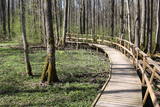 |
The excessively damp forests at this place include the Vēršupīte River bog, and this is one of the most diverse biotopes in Latvia in terms of the number of species that can be found here. The fact that the area is regularly flooded is shown by the fat roots of black alders – indeed, the place looks like a stand of mangroves. The wooden pathway that is the Dumbrāju trail starts at the Forest House for those who wish to examine the bog. The most impressive views are seen during spring floods or rainy seasons at other times of the year. The little river breaks out of its bed and floods a large territory. The Lake Sloka hiking trail is another place where you can study the Vēršupīte bog. The circular trail is 3 km long, and its beginning is at the Lake Sloka bird watching tower. |
|
 |
The restaurant, located on the bank of the River Lielupe in Jūrmala, offers modern Latvian cuisine and local produce. The special offer of the restaurant is smoked meats that are made based on traditions and years of experience. The restaurant is included in the prestigious Nordic White Guide, as well as in the Top 30 of Latvian Restaurants in 2019. |
|
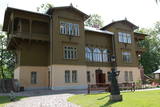 |
On the banks of the Venta River is a treasure of wooden architecture – the so-called Bangerts Villa, which relates to romantic stories and legends and was recently restored. It is said that a man known as Captain Bangerts bought the villa as a gift to present to his Parisian bride. The Kuldīga Administrative District Museum has been in the building since 1940. Since reconstruction, unique wall paintings and other interior design details have been restored, and the flat of the Bangerts family allows people to see how wealthy residents of the city lived in the early 20th century. Also on display are some of the sets of playing cards that have been collected by Jānis Mētra. |
|
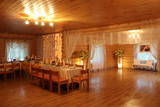 |
The farm engages in cattle breeding, fruit and vegetable growing, and production and processing of milk and meat. Contact the farm in advance to purchase homemade products, learn to make cheese, and bake your own bread on the basis of ancient recipes. This farm is part of the culinary heritage of Latgale. |
|
 |
Gegründet für den Schutz der Landschaften und der Seen der Aukštaitija-Anhöhe, Arten und Biotope. |
|
 |
Atrodas Kūrmājas prospekta turpinājumā pie gājēju ietves, kas ved uz jūru. Piemineklis (uzstādīts 1977. g.) simbolizē sievieti, kas gaida mājās pārnākam savu vīrieti. |
|
 15 days
|
The road trip from Vilnius to Rīga will take you to the most beautiful and important sightseeing places of the Next on the route is the Dubysa Regional Park, which includes the spectacular Dubysa river valley, historic churches and mounds along its banks. Be prepared, since the terrain of this area is rather rolling. Next, you will visit the town of Šiluva, which is a Catholic pilgrimage site, and then travel to the Tytuvėnai Regional Park, where you walk the natural trail of the lake of Gilius, which is part of the Forest Trail. The tour will continue in the Kurtuvėnai Regional Park, where you will walk one section of the Forest Trail from Kurtuvėnai to Šaukėnai, leading along small forest trails, educational trails, beautiful tree alleys and through wetlands. Then you will go to the region of Samogitia, visiting Telšiai and walk one of the Forest Trail sections along Lake Plateliai. Next, the tour takes you through the stone town of Mosėdis to Latvia, where you will stop over to have a walk on one of the oldest towns in Latvia – Aizpute, enjoying its 19th century wooden architecture and the local wine brewery. Next you will take a small walk along the Forest Trail in the eye-catching Kazdanga manor park and drive on to the most beautiful town of Kurzeme – Kuldīga. At the end of the tour, you will walk a section of the Forest Trail along the Abava River Valley Nature Park and nature trails in the Ķemeri National Park. |
|
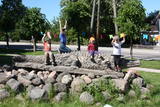 |
This 1995 sculpture by Oļegs Skarainis is at the corner of Dinsberģa and Talsu streets in Dundaga, near the local dairy. It is dedicated to the strong men of the town, including former Dundaga resident Arvīds Blūmentāls (1925-2006), who lived in Australia, was a great crocodile hunter (some 10,000 in all), and served as a prototype for Paul Hogan in the famous movie “Crocodile Dundee.” |
|
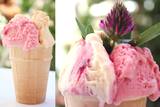 |
The family enterprise (formed in 2006) makes home-made ice-cream from fruit and berries. They make both classical – such as plombieres, cream, joghurt ice-creams and sorbets and nowadays cuisine’s „miracle”- sprat, blue cheese, horse-radish and potato ice-cream with tomato sauce. Till now 80 different ice-cream recipes have been tried. If you book a visit beforehand, you can have an excursion and learn everything about the process of making ice-cream from the chefs themselves. In the cafe it is possible to try different ice-cream dishes – each one with a different ice-cream sauce. The cafe also welcomes pets! Special foods: Horseradish ice cream with herring. |
|
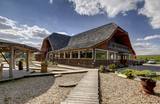 |
Lieliska vieta svinībām vai atpūtai Minijas ielejā Žemaitijā. Kafejnīca 100 pers. un konferenču zāle, kuras izvietotas 6 ha lielajā teritorijā. Spēļu laukumi gan bērniem, gan pieaugušajiem. Kanoe, burbuļvanna un pirts. Nakšņošanai viesnīcas numuriņi, koka namiņš vai 2-zvaigžņu kempings. Pieejama ēdināšana. |
|
 |
The bistro is 130 m from the Bērzkrogs crossing (opposite the Statoil petrol station). It works with local producers of ingredients that can be tasted or bought at the bistro. Souvenirs are also available. Latvian cuisine: Grey peas with bacon, grit porridge. |
|
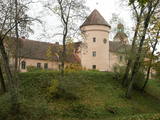 |
Every traveller in Latvia relates the name of Edole to Edole Castle. The beginning of it dates back to the middle of the 13th century, but the outbuildings of it were constructed in the 16th and 19th centuries, when patio was formed. During reconstruction of the castle implemented in the 30ies of the 19th century the facades of the castle acquired their current – Neo-Gothic appearance. From the16th century until 1920ies Edole Castle was located within the property of a baron family. In 1905 during rebellions it was burnt down, but in 1907 it was reconstructed. Many legends and ghost stories are told about Edole Castle. |
|
 |
Ancient Scandinavian gravesites are found near Grobiņa at the Liepu alley (as are the ancient Priediena graves). The skeleton, fire and hillock graves date back to the 4th to the 10th century. A dig in 1987 led to the discovery of a unique and richly ornamented gravestone from the 8th or 9th century which was produced in honour of a fallen Scandinavian soldiers. It is now housed at the Liepāja Museum of History and Art and is the only discovery of its kind in the south-eastern reaches of the Baltic Sea. |
|
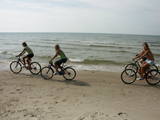 |
The “Nida-Pērkone” protected marine territory is one of the most biologically diverse marine territories along the shore of the open part of the Baltic Sea, and it is enormously important for environmental protection. The most important reef territories are found here. During migration season, most species of migrating birds that are found in Latvia cross the area. The territory is particularly important to protect the goosander and the little gull. The territory is opposite the Rucava and Nīca administrative districts and covers 36,703 hectares. It overlaps the marine section of the Pape Nature Park and the Bernāti Nature Park.
|
|
 |
For the first time, Balvi as populated area was mentioned in 1224. In the turn of 19th and 20th century, Balvi as manor and the parish centre formed as a larger settlement. During the Latvian freedom fights in 1919 Balvi was a place of establishment of Latgale guerrilla regiment. In 1926 Balvi obtained village rights, but by the 1928 became a town. During the World War II, while retreating, the German burnt down Balvi almost completely. People of Balvi are proud that the sun rises here about three minutes earlier than in the capital. Also the centre of the town has changed over the recent years. |
|


