
| No | Name | Description |
|---|---|---|
 |
Taka, kas izveidota Lemmjegi (Lemmjõgi) un Raudnas (Raudna jõgi) satekas vietā, iepazīstina ar palieņu pļavām un veciem pārmitriem mežiem, kas ir vieni no lielākajiem Igaunijā. Takas sākumā dominē atklātas lauku ainavas. Viens no 4,9 km garās lokveida takas apskates objektiem ir Lemjē dižozols. Mitrā laikā noderēs ūdensizturīgi apavi. |
|
 |
Vecpiebalgas vecajos kapos (Vecpiebalgas austrumdaļā, pa ceļam uz "Saulrietiem" un "Vēveriem") apskatāms piemineklis, kas veltīts brāļu Kaudzīšu romāna "Mērnieku laiki" personāžam - Lienai. Piemineklis uzstādīts 1987. g. (tēlniece M. Baltiņa). Pirms ceļojuma atkal ir jāpāršķirsta "Mērnieku laiki"! |
|
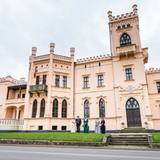 |
The castle was commissioned by Baron Alexander von Fittinghof and built between 1859 and 1863 in the late Tudor Neo-Gothic style. It is one of the most important monuments to this style in Latvia and has an ornate limestone façade. The 7th Sigulda Infantry Brigade was housed in the castle from 1921 until 1940. Today it is home to the Alūksne Museum with a permanent exhibition and an “environmental labyrinth.” One of the most unusual exhibits is a set of fluorescent minerals that can be viewed under lights with various spectrums. |
|
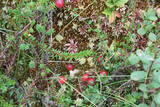 |
The territory has been established for protection of the bog and its habitat species. It is not appropriate for visits. North-east part of the bog can be slightly seen from the road Neveja – Lapmezciems on winter season. Further on Cirste direction is located on of most impressive oak trees in Latvia – Rigzemju ozols.
|
|
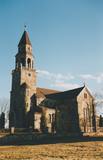 |
The church was built of fieldstones between 1908 and 1925 in the Tudor Neo-Gothic style (designed by the Liepāja-based architect Stadmann). It replaced a wooden church that dated back to 1621, and its steeple offers a lovely view of lakes that surround the village of Višķi. |
|
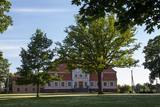 |
The Kelme Estate is one of the last remaining provincial estates in Lithuania. Designed in the Baroque style, it is a large and closed estate farm with many authentic buildings, gardens and bodies of water. The geometric park is a vivid example of Baroque style, and it is divided up into various parts by alleys. There is a viewing mound in the park. Most of the trees are ancient, indeed, but the best part of the estate is behind it -- one large and three smaller ponds, as well as a viewing mount that is in the ancient park. |
|
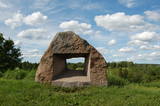 |
The open-air museum was proposed in 1992 by the sculptor Ojārs Arvīds Feldbergs, and it is located on the banks of the Ancient Abava River valley and on land that was once part of the Firkspedvāle and Briņķpedvāle estates. The park features contemporary art, and the museum also organises symposiums, creative workshops and other events. |
|
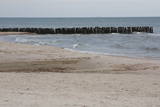 |
This is an enormously important territory for migrating birds. The most commonly spotted protected species of birds are the velvet scoter, the black scoter, the long-tailed duck, the little gull, the red-throated and black-throated loon, and the black guillemot. The territory is opposite the Dundaga and Ventspils administrative districts, and it covers 172,412 hectares.
|
|
 |
The farm offers a look at angora rabbits, which are very uncommon in Latvia. The owner offers tours, stories, rabbit wool, wool products such as mittens and socks, breeding rabbits and consultations. Children will love the animals and can feed them in the presence of the owner. |
|
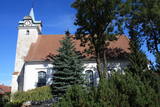 |
The church was built between 1640 and 1642 as a mark of respect for the king of Poland. It was commissioned by Duke Jacob Kettler and has a confessional bench with allegoric paintings (1691), as well as three altars decorated with Rococo carvings. There is a 16th century sculpture of the Madonna and her child. Contact the church for a tour. |
|
 |
Café Roomassaare is located near Kuressaare, providing a picturesque view of the Roomassaare yacht pier. In the summer season, the café mostly prepares dishes from local products, offering both locals and tourists a simple and clean combination of local flavours. A lot of fish as well! |
|
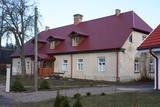 |
The estate owned by the dynasty of Baron Osten-Zaken was rebuilt in 1856 and 1857, because the old estate was sacked during the Crimean War (1853-1856). At the beginning of the war, British warships bombarded Latvia's shoreline and ships with the purpose of scaring the Russian tsar. Some of the gunfire hit Kolka, which was part of the Russian Empire at that time. After the estate was destroyed, the so-called White House was built there with a series of ancillary buildings. A mantel chimney was installed on the second floor, and it was used to smoke wild game (the chimney is still there). The estate belonged to the aristocrats until 1919, when its last owner, Christian von Osten-Zaken, was shot in Tukums. An elementary school, known as the Kolka School, was installed in the White House in 1929. It remained open until 1961, when a new school was built. Crafts lessons were offered at the building until 1989, at which time it was known as the Old School or the Small School. In 1991, the Old School was taken over by the Faculty of Biology of the University of Latvia, and it has been used for summer internships for students ever since 1994. |
|
 |
Stādaudzētava piedāvā rožu, skujeņu, dižstādu, ūdensaugu, lapu krūmu un dzīvžogu materiāla iegādi un konsultācijas.
|
|
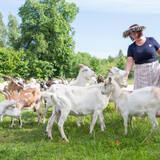 |
A Latvian traditional farm with a herd of some 150 goats, offering tours of the farm and cheese for sale. They offer also home-made ice-cream from the goat milk and a soup made on open-fire. Also latvian traditional sauna is available. The products can also be bought at the little market in Straupe. |
|
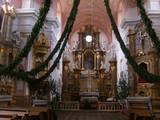 |
This is one of the most outstanding Catholic churches in Latvia. The current building was built in 1761 in the Polish Baroque style. The interior from the 18th century is original and very ornate. Each year there are spiritual music events and Polish cultural festivals here. The guide will give you a tour of the church and of other tourism destinations along the frontier line of the EU (please be sure to bring along your passport!). |
|
 |
Уютное кафе в центре Тукумса. Время работы: пн. – сб. с 10:00 до 18:00; вс.- закрыто. |
|
 |
The saloon is on the edge of the Rīga-Liepāja highway (A9) at the 22 km road marker. Most of the dishes are based on ingredients from the forest. The interior design is based on hunting, and there is a paddock of wild deer alongside the restaurant. Latvian cuisine: Roast buck, roast wild boar, venison steak, roast lamb, stuffed river trout. |
|
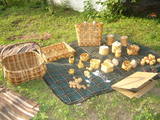 |
This is one of the few workshops in Latvia where things are woven with birch bark. You can look at the objects and discuss the experience of the craftspeople. They will help you to produce simple objects out of birch bark, and those will be excellent souvenirs. |
|
|
|
Neliela apdzīvota vieta, kuras apkārtnē jau izsenis iegūta kūdra un ārstniecības dūņas, kas izmantotas Ķemeru kūrortā. Kūdrā atrodas padomju laikā celtā dzelzsbetona rūpnīca, kura nodrošināja ar būvniecības materiāliem tagadējo Kauguru mikrorajonu.
|
|
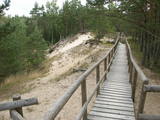 |
The trail climbs up and down along the bluffs of lower River Pilsupe and reveals a fascinating sight of three white dune exposures (the largest is called the White Dune). The trail is 900m long, and the White Dune is ca 20m high. It has formed ca 6000 years ago, in the period of the Littorina Sea which is a foregoer of the Baltic Sea. Here the first Stone Age settlement on the North Western coast of Latvia has been found in 1934 by geologist S. Burhards. In the sand, some 500m from the sea, he found some pottery fragments, a sandstone hone, a piece of flint, parts of bones and an amber bead. He handed the findings over to the National Museum of History. In October 1934, the site was checked by archaeologist E. Šturms, who found the archaeological layer, typical for such settlements, in the landslides of the Pilsupe riverbanks. In 1936 he started larger excavations to continue by 1938. Totally seven, chronologically different settlements were detected and many artefacts found, including fragments of the so called Sārnate and pit-comb pottery, as well as some pieces of corded pottery. Based on these findings, the settlement is dated back to the beginning or middle of the 3rd millenary B.C., and it has been inhabited till the beginning of the 2nd millenary B.C. Especially remarkable are three clay figures in human shape which have probably been used for some religious cult purposes. Since 1993, archaeologist Ilzes Loze has discovered several pit-comb ware culture settlements in large area around Pūrciems village. They are known in research literature as „the Ģipka settlements”. |
|


