Традиционные сыры Латвии
The history of Latvia’s traditional cheeses is fragmentary, because many records were lost or never written down, especially during the 20th century occupations.
Therefore this overview is not based on one “canonical” source, but on a body of evidence: historical publications, newspapers, archival materials, and oral testimonies recorded from people of different generations in Latvia.
In this section on traditional cheeses we focus on cheeses that are documented in Latvia before, or independently of, the Soviet industrial food system.
These cheeses illustrate the use of local raw materials, regional particularities, and long-term roles in everyday life and festive customs, and are thus regarded as part of our culinary heritage.
Ранние традиционные сыры в Латвии

Jāņu siers – John’s Cheese
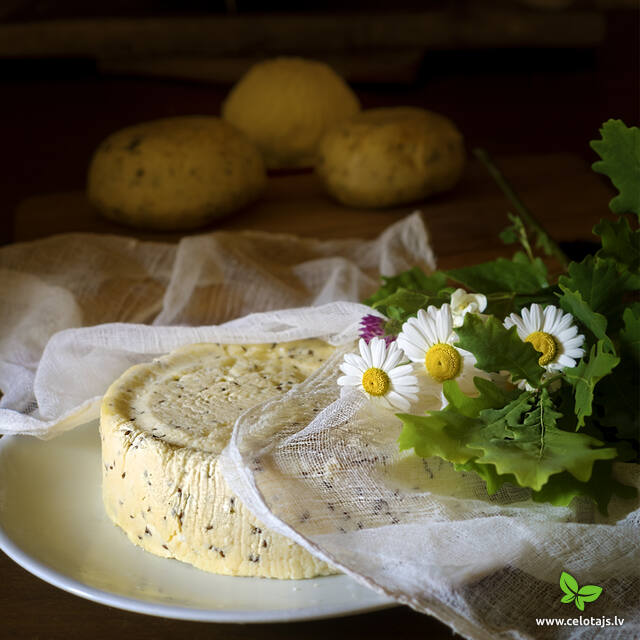
Jāņu siers (John’s Cheese) is a traditional Latvian sour milk cheese associated with the Midsummer solstice celebration (Jāņi).
It is made from milk and curd (biezpiens), flavoured with caraway seeds and shaped into a round wheel. Written sources mention this cheese from the 18th–19th centuries, and the tradition of making it has survived to the present day both in households and in dairies.
 Jāņu siers is registered in the European Union as a Traditional Speciality Guaranteed (TSG) product. Currently (as of March 2026), “Jāņu siers” with the European Union quality label “Traditional Speciality Guaranteed (TSG)” is produced in Latvia by ten dairy processing companies that make Jāņu siers according to the traditional recipe. These are: AS Lazdonas piensaimnieks, AS Rankas piens, PKS Straupe, AS Valmieras piens, AS Jaunpils pienotava, Jānis Lapsa (Lapsu mājas siers), ZS Juri, ZS Bļodiņas, Zs Dambīši 2, LPKS Baltu Piens.
Specialist dairy literature from the 1930s emphasises that the tradition of making this cheese was passed down from generation to generation. Women traditionally prepared the cheese and taught the craft to their daughters, and outside Latvian communities abroad this cheese was not known to be produced anywhere else.
Although each family prepares Jāņu siers slightly differently, using various additional ingredients and proportions, the basic recipe is essentially the same everywhere: “whole milk is heated in a pot over the fire, and an appropriate amount of curd is added.”
An interesting detail mentioned in older sources notes that in some regions the cheese was browned: it was spread with butter in a pan and placed in a hot bread oven until it became soft and golden brown. This practice may reflect the influence of Baltic Sea neighbours, particularly Finland, where a similar baked cheese (leipäjuusto) is made.
Pakša siers (Eave’s) or Kūdais (Thin) siers

Pakša siers (Eave’s Cheese) is a traditional product of Latgale, while a similar cheese known as Kūdais siers (Thin, poor Cheese) belongs to the culinary heritage of Lower Kurzeme.
It is a long matured, very hard curd cheese flavoured with salt and caraway seeds. Traditionally the cheese was dried outdoors in the sun and wind, often hung at the corner of a house under the edge of a roof, eave, (Latvian: paksis), from which it likely derives its name.
If the cheese was left hanging from spring until autumn, it could be stored throughout the winter.
The recipe itself is very simple: curd, salt and caraway seeds. The true secret, however, lies in the quality of the raw material — good curd made from excellent milk obtained from cows grazing in natural meadows.
Today the tradition of making Pakša cheese is preserved and continued at the “Juri” farm in Rušona parish.

Karaway cheese (Knapsiers)
Caraway cheese, also known as Knapsiers, was one of the most common dairy products found in rural households.
In the 1930s it was also produced in several dairies because it was, as noted at the time, “quite strongly demanded by city residents” (K. Lielgalvis, Sierniecība, 1930, p.461).
Traditionally, sour milk was first allowed to ferment, from which curd was prepared and then left to mature for one to three weeks. The layer of mould that formed on the surface of the curd was mixed back into the mass, together with salt and caraway seeds.
In wealthier households, sour cream or even butter was sometimes added. The mixture was then kneaded for a long time until it became elastic and easy to shape. Small cone shaped cheeses were formed, placed on wooden boards and left to mature.
When the surface of the cones became wrinkled and the cheeses hardened, they were ready to eat.
Knapsiers was most often made in summer, when conditions allowed proper drying and maturation. The cheeses were usually placed in small ventilated wooden cupboards set on posts in the garden or another suitable place. To prevent the cheese from drying too quickly and to protect it from insects, it was covered with burdock or rhubarb leaves.
After three to five days the cheese could already be eaten, but if it was left for two to three weeks it matured more fully and became much drier. In this form it was durable and could be stored for a long time
Biezpiens (Curd, often also called as cottage cheese)

Biezpiens is one of the oldest processed milk products known in the territory of Latvia. It is obtained by coagulating milk and separating the whey.
The earliest written sources that may refer to Biezpiens appear in 16th century sales documents of the Jesuit College of Riga, written in Latin, where the term coagula lactis (“milk curd”) is mentioned.
Historically, Biezpiens served as the basis for many fresh and dried cheeses and was also an important everyday food.
Its preparation is documented both in written sources and in oral tradition. Although Biezpiens is not usually considered a cheese in the modern sense, it plays a fundamental role in Latvian cuisine. Figuratively speaking, being made both in castles and in hovels, as the raw material could vary widely from rich whole milk to skimmed milk and even buttermilk.
Today it is known that Bieziens contains valuable proteins and is rich in calcium, iron, phosphorus and magnesium, as well as all essential amino acids. Possibly due to the growing interest in healthy diets, Biezpiens produced in Latvia is currently gaining popularity abroad.
It is is also one of the traditional dairy products whose production did not cease during the postwar occupation period, and today Biezpiens is made in large dairies, on small farms and in home production kitchens.
Позже были введены традиционные сыры.

Zaļais siers - Green Cheese
Green cheese originates from the Canton of Glarus in Switzerland. The finished cheese has a grey - green colour and a distinctive aroma of blue fenugreek (Melilotus coerulea). The cheese was first mentioned in 1429 in a list of products available at the Zurich market.
It is not entirely known how this cheese reached Latvia more than a hundred years ago, but it quickly became a popular local product.
The essential herb, blue fenugreek, is an annual plant that also grows in Latvia. For Green cheese, the ground green parts of the plant are added to the milk-protein mass, which is later thoroughly dried.
It is this plant that gives the cheese its characteristic aroma, flavour, and beautiful grey-green colour.
Today the tradition of Green cheese is continued by the company “Siera ražotne”, which both cultivates blue fenugreek and produces the cheese.
"Latvijas" siers - Semi-hard cheese “Latvia”

Cheese “Latvia” is a semi-hard cheese made using a special technology and matured in carefully maintained cheese cellars. The ripening process gives the cheese its rich, piquant aroma while maintaining a mild flavour with a subtle creamy note. During maturation, lactic acid bacteria together with the specific bacterium Brevibacterium linens form a sticky orange layer (smear) on the surface of the cheese rind.
Cheese “Latvia” is more than simply a dairy product: it represents a story, a tradition, and the carefully refined craft of Latvian cheesemakers. Today this tradition is continued by the dairy company “Smiltenes Piens”.
“It is a typical Latvian cheese that over time developed from Limburg and Bakstein cheeses and was incorrectly called Bakstein cheese. Apart from the name and the square shape, it has little in common with Bakstein cheese. The name Bakstein was given by Western European cheesemakers whom German landlords had earlier brought to work in our country.” (K. Lielgalvis, Cheesemaking, 1930, p. 318)
The history of this cheese is quite multifaceted and over time it has appeared under several different names, including: “Holstein”, “Bakstein”, and during independent Latvia also under the name “Zemgale”.
By the 1930s, Zemgales cheese, which can be considered the predecessor of today’s cheese “Latvia” was already described as a distinct cheese variety characteristic to Latvia. Contemporary literature emphasised that this cheese was made from “richer milk”, unlike the cheaper Backstein cheese. It also noted that the ripening process in the cellar was carried out “with particular care”, and that cheesemakers did not aim to produce the cheese “as cheaply as possible, as was done with Backstein cheese.” (ibid., p. 318)
At a meeting of representatives of dairy cooperatives and dairy organisations held on 11 November 1928 it was decided that this cheese should henceforth be called “Zemgale” cheese. This designation could only be used if the fat content of the milk was not lower than 1.5%, and the fat content in the cheese dry matter was not less than 30%. (ibid., p. 319)
Tilzītes siers - Tilsiter

Tilzīte cheese, or Tilsiter (German: Tilsiter), is a semi-hard matured cheese variety with small irregular eyes that originated in the 1820s.
Until the mid-19th century, Tilsiter was produced and consumed only in East Prussia. Toward the end of the century, Swiss dairy farmers Otto Wartmann and Hans Wegmüller, returning to Switzerland from East Prussia, introduced its production to the Alpine region. From the surroundings of Tilsit, the cheesemaking tradition also spread westward along the Baltic Sea, eventually reaching Latvia. By the 1930s, Latvian cheesemakers already referred to Tilsiter as a widespread and popular cheese.
“Tilsiter cheese received its name from the town of Tilsit in East Prussia, where it was first produced.” (K. Lielgalvis, Cheesemaking, 1930, p. 328)
Originally the cheese was made similarly to other semi-hard cheeses but was not placed in a press; instead, the curd grains were left to self-press. The curds were placed into moulds lined with cheesecloth and lightly pressed by hand. The separation of whey was encouraged through repeated turning and rewrapping in fresh cheesecloth.
After removal from the moulds, the cheese was dried for 1–2 days and only then salted. Depending on the facilities of the dairy, salting was done either by dry salting or by brining. Cheesemakers believed that dry salting produced a better flavour, but brining required less labour and was therefore more common in larger dairies.
After salting, the cheeses were left to dry for 5-6 days. They were then transferred to cellars to mature for 3-4 months at a temperature of 15-18 °C and humidity of around 90%. A natural smear was allowed to form on the rind, but only slightly, so the cheeses were regularly wiped with a clean cloth; initially three to four times per week, later twice per week was sufficient. (ibid., p. 332)
In the 1960s, the Soviet Union began producing a cheese derived from the Tilsiter recipe at the Uglich dairy factory in the Yaroslavl region. Manufactured in a slightly modified form and marketed under the name “Russian cheese”, it was later distributed widely throughout the Soviet Union, including Latvia.
Unlike traditional Tilsiter, Russian cheese typically has a stronger flavour, a lower moisture content and a more irregular eye formation. Its maturation doesn’t involve rind washing ripening, and production doesn’t always call for highest quality milk.
Since the restoration of Latvia’s independence, there has been no unified standard for Russian cheese in Latvia, and differences existed between products made by different dairies. In response to Russia’s invasion of Ukraine in 2022, producers and retailers in Latvia have increasingly begun to abandon the Soviet era name of this cheese.
Другие традиционные сыры
Zemgales siers - Cheese “Zemgale”
Cheese bearing the name “Zemgale” was already produced in Latvia in the 1920s. As noted in the section on cheese “Latvia”, this earlier Zemgale cheese is considered one of the historical predecessors of the modern smear ripened cheese known today as “Latvijas” siers (cheese “Latvia”).
At the same time, the name “Zemgale cheese” was later used for another product introduced during the Soviet period in the 1960s. This cheese was produced by the Bauska dairy plant (Bauskas piens) and was described at the time as a new variety. Whether this Soviet era cheese was essentially the same as the earlier Zemgale cheese or represented a different product produced under the historical name is still viewed differently by dairy technologists and historians.
On 3 July 1968 the newspaper Rīgas Balss reported: “The Bauska dairy plant has begun producing Zemgale cheese. The new cheese contains 50 percent fat and has a sharp aroma and flavour. It will have a longer maturation period and a more refined external appearance.”
In the context of traditional Latvian cheeses, however, the name “Zemgale cheese” generally refers to the earlier cheese produced during Latvia’s independence period, a close relative of Limburg and Backstein cheeses.
Suliņu siers - Whey Cheese
Suliņu cheese, also known as whey cheese, is a mild, creamy, slightly grainy product made by heating whey, the by-product of cheesemaking. In earlier times whey was commonly referred to as suliņas.
In the 1930 publication Cheesemaking issued by the Agricultural Administration, Suliņu cheese is mentioned among traditional Latvian cheeses whose existence had, even at that time, been largely forgotten.
On larger and wealthier farms where cheese was produced in greater quantities, enough whey was available to prepare Suliņu cheese as an additional product.
Fresh whey was first mixed with a small amount of slightly cultured (soured) whey and heated almost to boiling. More sour whey was then added and the mixture heated again. After about an hour the Suliņu cheese would settle at the bottom of the pot, leaving clear whey on the surface. The clear whey was poured off, and the curd like mass remaining at the bottom was transferred into cloth to drain.