
| No | Name | Description |
|---|---|---|
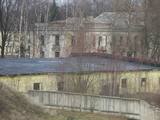 |
The Swedish army built a modern fortress during the 1640s with five bastions and two gates. There were 120 cannons and mortar throwers, barracks for soldiers, flats for officers, a garrison church and warehouses for food at munitions. After the Great Northern War in 1710, the fortress was taken over by the Russian army. After the Soviet occupation in 1940, the Soviet navy took over the fortress. Alongside it is a former Soviet army facility with abandoned buildings and a monument to sailors who served in submarines. The fortress is open for tours on Saturdays and Sundays. |
|
 |
The farm breeds cattle and grows vegetables. You can receive consultations and purchase seeds and vegetables. |
|
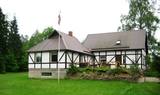 |
Guest house "Aivari" is located in a quiet forest in Inčukalns region. Offers rest in a country sauna, after the sauna it is possible to use a shower, cool off in the pool, also a swim in the spring pond and a wooden tub. There are tent sites, a picnic area with awnings, a volleyball net and several campfire sites. |
|
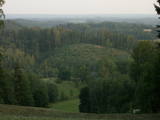 |
From the highest point in the Alūksne highlands, you will see an unusually beautiful view of the surrounding forested hillocks and the small areas of meadows and farmland. Sadly, there are no improvements to the location, which can be difficult to access. It is on private property.
|
|
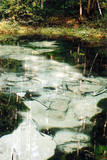 |
Three little lakes can be found on the left bank of the Pirita River with many erupting “eyes” of streams, each with its own colour (bluish-green, white, dark). This puts together various colour combinations. These are often known as the most beautiful streams in Estonia. Some pump out as much as 20-30 litres of water per hour. It is said that the waters are good medical resources, particularly for the eyes. There are improvements in the area of tourists.
|
|
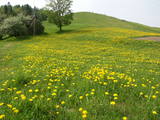 |
This is a view worth a journey from a distance. This is an impressive terrain for Latvia, and here you will see as far as the Hanja highlands of Estonia, where the Great Munameģis Hill – the highest surface in the Baltic States – can be found.
|
|
 |
This village is at the place where the Irbe (Dižirve, Īra) River flows into the sea, and it is on both shores of the river (sea side and land side). The name of Irbe was recorded for the first time in a 1310 border agreement between the bishop of Kurzeme and the Rīga Dome Capitol. The name of Lielirbe (Irvemūnde) was recorded for the first time in a document from an arbitration court in 1387. At the end of the 19th century, the small port at Lielirbe was an active centre for the sale and transport of timber materials. In the late 19th and early 20th centuries, the largest number of sailing ships among villages on the western shore of Kurzeme was built there. In 1939, the village had some 300 residents, more than 70 houses and a Baptist church which is now at the Ventspils Open Air Museum. A narrow-gauge railroad passed through the village, which had a post and telegraph office, two grocery stores, an elementary school, a choir and a brass band. Lielirbe was one of the largest villages to disappear after World War II. Cultural historian Valda Marija Šuvcāne (1923-2007) was born in Lielirbe, and her daughter, Baiba Šuvcāne, is continuing her mother's work by writing important papers about life along the Livonian coastline. By 2019, a bridge is to be reinstalled across the Irbe River. |
|
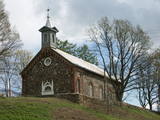 |
The Sarkaņi Catholic Church is on the western shore of Lake Cirms, and it was built of field stones in 1830. The church is famous for a painting of the Virgin Mary which is said to be miraculous. This is a popular destination for pilgrims as a result of this fact. |
|
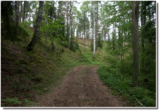 |
The Green Dune is beyond the Krāči hills (Krāckalni)
and is the second most distinct dune formation in the
national park. It runs for more than three kilometres,
separating the Raganu and Zaļais swamps. An old
earthen road is at the foot of the dune, and that’s the
basis for the route.
|
|
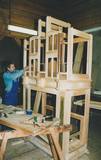 |
This is the only place in Latvia where old organs are restored and new ones are built. The workshop also manufactures music boxes. Tour groups can learn about the history and principles of organ building and about the instruments as such. The workshop was installed in the stable of a former manse in 2004, and it is owned by Jānis Kalniņš. |
|
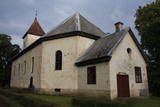 |
Целостное здание церкви строилось в 1780 – 1781 гг. во времена барона Х.Ф. Бера, а перестраивалось в 1876 и 1888 гг. Церковь известна своим алтарем и кафедрой, выполненными в стиле рококо, и построенным в первой половине XVIII века органом. Церковь можно осмотреть изнутри. |
|
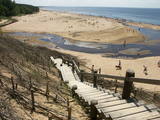 |
The White Dune is one of the landmarks of Saulkrasti, on the Vidzeme gulf coast. The dune offers a splendid view of the sea, the mouth of the Inčupe River and the vast beach. The White Dune formed as the wind drove beach sand over the clay silt of Baltic Ice Lake. Its white 18 meters high sand outcrop once helped local fishermen find their way home. The dune got its name from its white, hardened layers of sand which look like sandstone. |
|
|
|
Iespaidīga smilšakmens atsegumu virkne, kas
izveidojās pēc 2005. g. orkāna.
|
|
 |
Naissaar is a small island near Tallinn which was exclusively used by the Soviet military from 1945 to 1993. Attractions on the island include walking trails, varied habitats, a narrow-gauge railway, fortifications from the early 20th C, and a Soviet naval mines factory. |
|
 |
Jaunciems has always been a small village, and only a few homes are populated today. Nearby there are leisure locations on the right bank of the Irbe River. Jaunciems is linked to Sīkrags by the former tracks of the narrow-gauge train. There is also a bridge for hikers and bicyclists. |
|
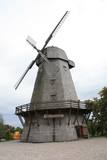 |
The windmill was built between 1867 and 1869 after a design first produced in the Netherlands. Its name is that of its first owner – Riba. The windmill is one of the best preserved architectural monuments of its type in Latvia, and it offers an educational exhibition, “The Path of the Grain.” It talks about the development of agriculture in Zemgale and about grain farming and the baking of bread. Guided tours are available. The windmill is part of the Rožmalas leisure complex, which features a hotel and a restaurant. |
|
 3 days
|
The Suiti are a community with among the most colourful and unique cultural traditions in Kurzeme and Latvia. This was confirmed on October 1, 2009, when the cultural territory of the Suiti was included in the UNESCO list of global intangible cultural heritage, thus indicating that the traditions must be preserved. The Suiti territory is also on the list of folk traditions that is part of the Latvian Cultural Canon. Manifestations of this intangible cultural heritage include traditional festivals, habits, oral traditions, traditional singing and musical skills, folk costumes and culinary traditions. Since 2009, the Suiti community has been undergoing a renaissance, with people actively working to restore traditions and ensure their sustainability and promotion at the local, national and international level. The survival of the cultural territory is in the hands of the Suiti themselves, and this is closely linked to the practices and the creativity of community representatives. The Suiti believe the development of tourism in their area to be of great importance in this. This means emphasising a niche in cultural tourism that is based on the broader promotion of the unique cultural heritage of the Suiti. |
|
 |
Piemājas saimniecība nodarbojas ar augļkopību un biškopību! |
|
 |
Vastseliina Castle dates from between the 14th and 17th centuries; during this time it was a mighty stronghold on the border between Russia and Europe and in the Middle Ages it was also a pilgrimage destination, it was destroyed in 1702 during the Great Northern War. |
|
 |
"Pūpoli" is located on the coast of the Gulf of Riga, 50 metres from the sea. Visitors have the opportunity to observe the preparation and smoking of fluke, vimba, bream, perch and other fish, as well as to purchase and taste them. |
|


