
| No | Name | Description |
|---|---|---|
 3 days
|
Here you will learn about home-based manufacturers, farms, companies and others in northern Vidzeme that produce various dairy products such as milk, yogurt, cottage cheese, cheese, ice cream, etc. You’ll start out in Cēsis with its Medieval old town, castle ruins, St John’s Lutheran Church and other destinations. Wind your way through the Gauja National Park (Ungurmuiža, Lake Ungurs, the Medieval castle and church at Straupe). You’ll hit the seashore at Saulkrasti and then drive along it to Tūja, where you will turn inland again. In Limbaži you will find Medieval castle ruins, a monument to the great folklorist Krišjānis Barons and other objects. Drive on to Valmiera (St Simon’s Church, castle ruins, a museum, Emotion Park, etc.), Rūjiena and Naukšēni (the Naukšēni Estate). Along the “Northern Pathway” you will reach Kārķi and then Smiltene and legendary Rauna (the Raunas Staburags cliff) before returning to your starting point. |
|
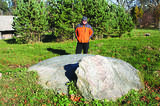 |
The surface of the rock once contained
text about the destruction of local Livs by Swedish King Charles IX and by the Black
Plague (the rock is on a spot where victims of the plague were buried, and the text
has been erased over the course of time). The smallest rock on the top, which also
used to have an inscription, has been brought here from the Pakalni homestead.
|
|
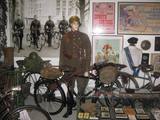 |
This collection contains bicycles from five different armies and five different eras in the history of Latvia. They include a World War I bicycle from the Russian Empire, a bicycle from the Latvian army, two World War II German bicycles, and a Monark-brand military bicycle from Sweden that was donated to the renewed Latvian army in the 1990s. The exhibition also features items that are related to the use of military bicycles – seals, awards, and information about the bicycle units of Latvia’s Home Guard.
This is the only bicycle museum in Latvia, and its exhibits are unique, as well.
|
|
 |
2015. gadā uzceltais skatu tornis atrodas dabas parkā „Daugavas loki”, Daugavas ielejas kreisajā krastā – Daugavpils novada Vescalienas pagastā. No torņa aplūkojama izcilā Daugavas loku ainava. |
|
 |
The breeding of Californian red snails and production of bio-humus. You are offered a short excursion around the production, information about breeding snails and the production of bio-humus. |
|
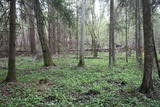 |
One of the rare places (see also Rucavas ivju audze) in Latvia where two rare and protected wild tree species grow - yew-tree and Baltic ivy. Territory is not marked on site with information signs or stands therefore it is hard for visitors to find. Not usable as tourism object.
|
|
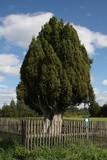 |
This is the thickest common juniper (Juniperus communis) in Latvia and the Baltic States. It stands in the middle of a field and looks wonderful. The tree is sometimes known as the Rieteklis juniper, because the Latvian poet Rieteklis (Jūlijs Eduars Balodis, 1856-1940) like to sit under it.
|
|
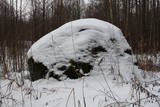 |
The historic stone, on which there is carved over 200 years old boundary-mark, sets the border between the Duchy of Courland and the Russian province. Nowadays, it sets the Babīte and Jelgava district boundary. The stone lies to the East of Kalnciems–Peat road (the south of the swamp Labais purvs) at the edge of a forest firebreak and it can be hard to find. To this end, the description of the road map may help: around 400 m south of the car parking lot at Lily Lake from Kalnciems-Peat road to the right (in the east) turns a forest road which leads down from hills Krāču kalni. It should be around 170 m to go until it abruptly turns to the right (to the southeast). Then you must go in this direction until after ~ 0.5 km to turn to the northeast where after further ~ 0.4 km of the current forest road intersection turn to the north. After ~ 0.4 km turn right (to the east) on a big firebreak, on the left (the north) side of which behind the drainage ditch during the non-leaf period there can be seen a rounded stone. Due to the poor condition of roads, the stone can be reached only on foot. |
|
 |
Der Turm war der Eckturm der mittelalterlichen Stadtmauer von Pärnu. Der Turmhof ist ein beliebter Ort für Kunsthandwerkermärkte und ein Veranstaltungsort. |
|
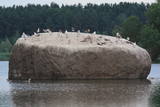 |
The Radžu stone is located to the South of Jēkabpils and at the north-eastern part of the Radžu sand and gravel quarry (the Radžu reservoir). The stone is the second largest rock in Latvia with a size of nearly 100 m3. At one edge of the quarry is the Jēkabpils Forest Park, which is popular among residents and their guests for leisure, hiking and sports. The beach of the reservoir was granted the Blue Flag in 2012. |
|
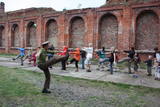 |
An impressive set of military structures between the Baltic Sea and Lake Liepāja and Lake Tosmare. Construction of the fortress began in the late 19th century on the basis of a decree by Russian Tsar Alexander III, and it cost 45 million gold roubles. The fortress includes accommodations and elements of fortifications – sites for cannons, trenches, gunpowder cellars, systems of canals, a narrow-gauge rail line, etc. In 1908, the fortress was shut down because of a change in Russia’s defence concept, and the construction of it was declared to have been a strategic mistake. There were attempts to blow up the underground structures and cellars during World War I, but that did not really succeed. Some elements of the fortress were of great importance in Latvia’s liberation battles. Surviving today are the Northern forts, the Central fort, the Eastern fort, the Southern fort, the shoreline defensive batteries (No. 23, 3), Redāns, Lunete, and others. Most are not improved, so visits may be dangerous. The northern part of the fortress includes the Military Port, which has experienced seven different armies and regimes. During the Soviet years, it was closed to civilians. There are many outstanding monuments to military history. Tourists love the Karosta prison, which offers educational programmes. |
|
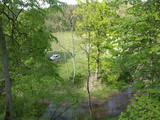 |
The viewing area is near the top of the Vilce castle hill, with a view of the Rukūze River valley, Zaķi meadow, and surrounding forests. This is an unusual landscape for the region of Zemgale. The Vilce baronial estate is nearby.
|
|
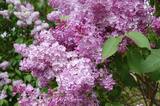 |
The Gardening Institute is the leading scholarly centre for fruit and vegetable research in Latvia. The institute specialises in selection and introduction of plant cultivars that are suitable for cultivation under the agro-climatic conditions in the Baltic countries, have high nutrition value and are rich in fibre content. |
|
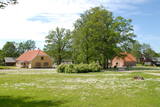 |
The Turaida Museum Reserve is found at the place where the deep gullies of a number of small streams split up the right bank of the ancient Gauja River valley. The Turaida Museum Reserve features monuments of Baltic importance, and their history dates back more than 1,000 years. Among the treasures are the Turaida Estate (21 buildings), the grave of the Rose of Turaida, the Turaida Lutheran Church (one of the oldest wooden churches in Latvia, 1750), and the Turaida Castle. Nearby is Folk Song Hill, where various thematic events are organised. |
|
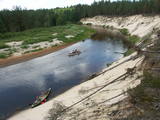 |
This comparatively large territory is found to the South of the Irbe River and Stende River, and it is unique with more or less virginal forests and dunes. The Irbe River has a system of ancient tributaries, and the Dižpurvs swamp is parallel to the shoreline. The Irbe has become a popular river for water tourism in recent years, but the tourist infrastructure on its banks remains insufficient. Territory has good road connections and has potential for nature education activities. |
|
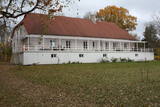 |
Muiža vēsturiskajos avotos ir minēta jau 1560. gadā. Tagad redzamā kungu māja ir celta no akmens 1805. g. Padomju laikos tajā atradās Matsalu rezervāta administrācija, bet mūsdienās ēkā ir izveidota viesnīca. Līdz muižai nokļūstam pa skaistu aleju, kuras apkaimē ir redzamas citas muižas kompleksa ēkas. |
|
 |
Piedāvā ļoti gardus Lietuviešu tradicionālos ēdienus. Var pieņemt līdz 300 personām. Ir āra terase un dzīvā mūzika. Pieņem bankas kartes, pieejama autostāvvieta. |
|
 |
Latvijas Valsts mežu laivu bāzē, kas atrodas Kaņiera ezera dienviddaļā (redzama no Lapmežciema – Antiņciema ceļa) kopā ar laivu bāzes ēku apvienots skatu tornis, no kura lieliski pārredzama ezera austrumdaļa. |
|
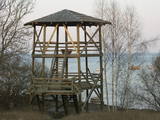 |
This tower is on the shores of the ancient Litorine Sea, with a lovely view of the unique seashore here – complete with small bays and capes. It is part of the Kaltene nature trail, which is around one kilometre long. The location is of particular interest during spring or autumn migration of birds. Two other bird-watching platforms are nearby.
|
|
 |
Die im 19. Jh. gebauten Mühlen sind vollständig renoviert. Eine Erzählung über ihre Geschichte und einem originalen Arbeitsmechanismus. |
|


